
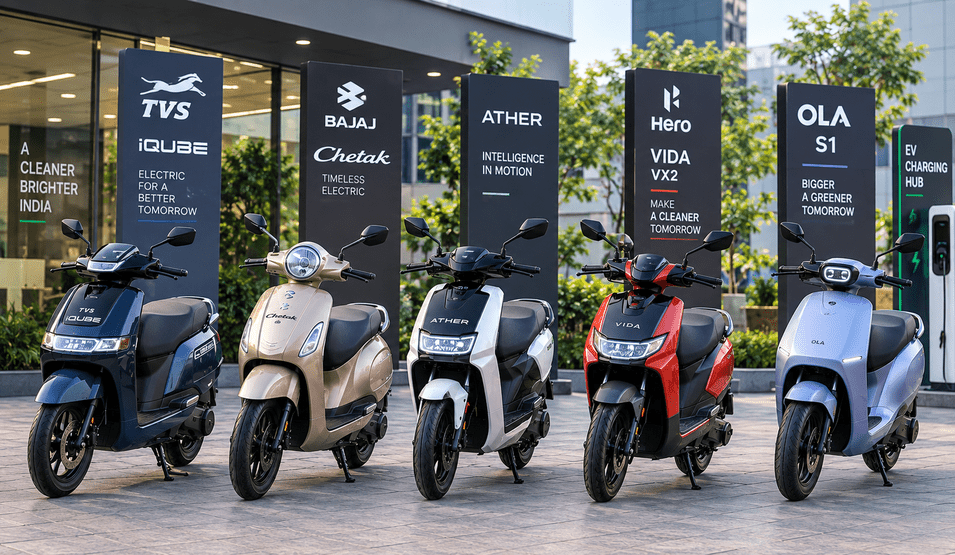

The list of India’s best-selling electric scooters looks mostly the same as it did two years ago, with one quiet but meaningful change: Hero’s Vida has moved ahead of Ola Electric on sales volume. That’s not a small detail. Ola built its early reputation on being the aggressive, tech-forward disruptor of this market, for a while, it was the clear leader. Registration data through 2026 tells a different story now, and it says something about what Indian buyers are actually prioritizing when they walk into a showroom.
TVS, Bajaj and Ather continue to hold the top three positions by volume, largely unchanged. What’s shifted is the order behind them, and the reason isn’t a spec-sheet war, it’s dealer networks, service turnaround, and which brand a buyer trusts to still be reliably supporting their scooter two years after the sale.
What happened
Based on brand-level registration data tracked through 2026, TVS remains the clear volume leader, driven mainly by the iQube, with Bajaj’s Chetak in second and Ather’s Rizta-led line-up in third. Hero’s Vida brand has moved into fourth, ahead of Ola Electric, which now sits fifth, a reversal from where the two stood as recently as 2024, when Ola was still the dominant name in this segment. Month-by-month figures through the middle of 2026 show Vida’s registrations consistently outpacing Ola’s, rather than this being a one-off month.
Key details: what each scooter actually offers
TVS iQube: The top-spec iQube ST variant, with its 5.3 kWh battery, carries a claimed IDC range of 212 km, among the longest in this list. TVS also quotes roughly 32 litres of underseat storage on this variant. Its main draw isn’t a single standout number, though, it’s TVS’s dealer and service network, built over decades of selling petrol scooters, which gives buyers confidence that support won’t disappear a year after purchase.
Bajaj Chetak: The Chetak 3001 starts at roughly ₹99,990 and is rated for 127 km of range with 35 litres of boot space, enough for a full-face helmet, which matters more to daily commuters than an extra 50 km of range they’ll rarely use. Chetak’s appeal leans heavily on Bajaj’s brand recall and a design that hasn’t strayed far from the scooter’s original 1970s silhouette, which continues to resonate with a specific buyer segment.
Ather Rizta: Positioned as Ather’s family-oriented scooter, the Rizta’s IDC-claimed range runs from about 159 km to 161 km depending on the battery variant, with roughly 34 litres of storage. It comes with Ather’s connected-scooter software stack, which has become one of the more differentiated parts of its pitch to buyers who want a smart dashboard and OTA updates alongside daily practicality.
Hero Vida VX2: This is where things get more layered than a single spec allows for. The VX2 range spans two sub-variants: VX2 Go, with 2.2/3.1/3.4 kWh battery options rated for 93 km, 127 km and 146 km respectively, and VX2 Plus, with 3.4/4.4 kWh options rated for 146 km and 187 km. Every VX2 variant uses a removable battery pack that can be charged off the scooter, at home, at work, wherever there’s a socket, which sidesteps the need for dedicated charging infrastructure entirely. Combined with Hero’s dealership reach, that’s a genuinely practical advantage for buyers without home charging access.
Ola S1: Ola’s line-up includes long-range variants such as the S1 Pro, rated at up to 242 km with an 11 kW motor, on paper, the strongest range-and-performance combination on this list. Ola’s pricing has also stayed aggressive relative to rivals. What the spec sheet doesn’t capture is the pattern in the sales data: strong numbers on paper haven’t translated into sustained volume leadership the way they once did.
| Model | Claimed Range | Notable Spec |
|---|---|---|
| TVS iQube (ST 5.3kWh) | 212 km | ~32L storage |
| Bajaj Chetak 3001 | 127 km | 35L storage, from ~₹99,990 |
| Ather Rizta | 159–161 km | ~34L storage, connected features |
| Hero Vida VX2 (Plus, 4.4kWh) | 187 km | Fully removable battery |
| Ola S1 Pro | up to 242 km | 11 kW motor, long-range variant |
What it means for EV buyers
The clearest signal in this list is that raw range numbers aren’t deciding sales anymore. Ola’s S1 Pro range beats everything else here on paper, and it isn’t the volume leader. What seems to matter more in practice is whether a buyer can get their scooter serviced without a long wait, whether spare parts are easy to source, and whether the charging situation fits their actual daily routine, which is exactly why Vida’s removable-battery approach and TVS’s dealer depth are pulling real weight in the sales numbers, not just in marketing copy.
If you’re shopping in this segment, it’s worth testing the service experience before the purchase decision, not after: ask your local dealership about typical service turnaround time and parts availability for the specific model you’re considering, since that varies more by city and dealer than by brand reputation alone.
What next
None of these five manufacturers has announced a major new scooter launch that would reshuffle this list in the immediate term. The more relevant thing to watch is whether Ola Electric’s ongoing efforts to rebuild its service network, a process the company itself has acknowledged is underway, manage to arrest its slide, or whether Vida and the legacy players continue pulling further ahead.
Conclusion
Two years ago, a list like this would have put Ola at or near the top without much debate. That it now sits fifth, behind a company using seven-decade-old dealer relationships and a removable battery pack, says more about what actually keeps an EV scooter buyer happy than any range figure does.
Also Read: India’s Top EV Leaders



[…] History and the market don’t always keep the same scorecard, and Maini is about as clean an example of that gap as you’ll find.Also Read: Top 5 Most Selling EV Scooters India 2026 […]