Ola Electric Is Changing How It Sells Scooters: Why the Dealer Move Matters After Its Market Share Slide

Ola Electric is changing one of the most important parts of its business model. After building its electric-scooter business largely around company-owned stores, the company is now opening its sales and service network to dealer partners across India.
The move, announced in August 2026, comes at a very different point in Ola’s journey. The company once dominated India’s electric two-wheeler market, but its share has fallen sharply as TVS, Bajaj, Ather and Hero have expanded their products, distribution and after-sales networks.
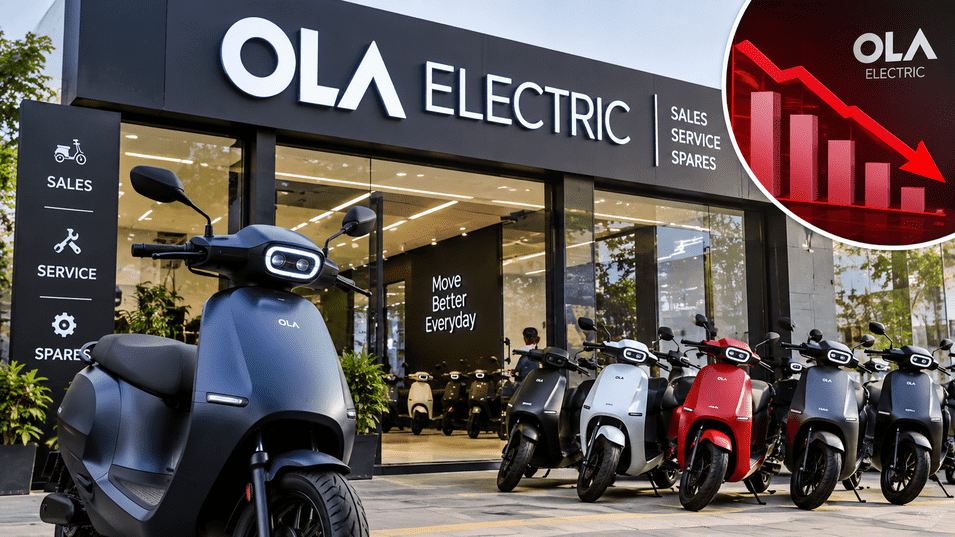
Ola says the dealer transition is about taking EVs deeper into towns and neighbourhoods as the category matures. For the company, however, the timing is significant: its H1 2026 registrations fell 44.1% year-on-year to 65,999 units, while its market share dropped from 18.6% to 6.8%.
The bigger story, therefore, is not simply that Ola is opening dealerships.
It is that distribution and service have become a much more important battleground in India’s electric two-wheeler market.
Ola’s direct-to-consumer model is entering a new phase
When Ola entered the electric scooter market, it took a different route from traditional two-wheeler manufacturers.
Rather than relying heavily on conventional dealerships, the company built its own retail footprint. Ola said this helped it create awareness around EVs, establish the brand and build a customer base of more than one million riders.
That strategy made sense during the early phase of India’s EV adoption.
But the market has changed.
Consumers are now comparing Ola scooters with products from companies such as TVS, Bajaj, Ather and Hero. These manufacturers have been expanding their physical sales and service networks while the overall electric two-wheeler market has continued to grow.
Ola is now responding with a different distribution model.
Under the new strategy, its company-owned stores will increasingly focus on brand and product experience, while dealer partners will handle local sales, service and network expansion.
Ola is targeting more than 500 dealerships
Ola announced in August that it expected to build a full-fledged dealership footprint by Diwali 2026.
Its FY2026 annual report, published subsequently, provides a more specific target: the company said it was targeting more than 500 dealerships over the next couple of quarters. The first cohort of dealer-operated stores had already begun covering cities and towns across states including Rajasthan, Tamil Nadu, Maharashtra, Bihar, Telangana, Uttar Pradesh and Madhya Pradesh.
That is important because Ola is not simply adding a few franchise outlets.
It is attempting to make dealer partners a core part of its national sales and service architecture.
The company has also positioned the network opportunity around its installed customer base, vehicle portfolio and recurring service potential. Its current network-partner programme highlights sales support, training and access to the company’s scooters, motorcycles and energy products.
Why the timing matters: Ola’s sales have fallen sharply
The dealer strategy becomes more interesting when viewed alongside Ola’s sales performance.
During January-June 2026, Ola recorded 65,999 electric two-wheeler registrations, down 44.1% from 118,032 during the same period of 2025.
Its market share declined from 18.6% to 6.8%.
At the same time, India’s electric two-wheeler market expanded significantly.
That distinction matters.
Ola is not dealing with a market that has stopped growing. Instead, competitors have captured a large portion of the additional demand.
TVS, Bajaj, Ather and Hero together accounted for 95.6% of the industry’s incremental electric two-wheeler registrations during H1 2026. Their combined share increased from 66.6% in H1 2025 to 76.7% in H1 2026.
For Ola, expanding physical distribution therefore has a clear strategic logic: it needs more opportunities to put scooters in front of customers and make ownership support easier to access.
The network gap is becoming harder to ignore
The difference between Ola and its established rivals is particularly visible in distribution.
| Brand | Network position | Latest reported figure |
|---|---|---|
| Ola Electric | Moving toward dealer-led sales and service | Targeting 500+ dealerships |
| TVS Motor | EV dealer network plus large wider sales/service ecosystem | 1,000+ EV dealers; 3,300+ iQube touchpoints |
| Bajaj Auto | Chetak-specific retail plus wider Bajaj network | 500+ Chetak Experience Centres; 4,000+ touchpoints |
| Ather Energy | Dedicated EV retail and service network | 700 Experience Centres; 548 Service Centres |
Sources: respective company disclosures and FY2026 reporting. Figures are from different reporting dates and definitions, so they are not a like-for-like measurement of current physical outlets.
TVS reported a 1,000-plus EV dealer network in its FY2026 annual report. Its iQube has also been supported by more than 3,300 sales and service touchpoints across more than 3,000 cities.
Bajaj, meanwhile, reported more than 500 exclusive Chetak Experience Centres and more than 4,000 touchpoints across India.
Ather’s network has also expanded quickly. The company reported 700 Experience Centres and 548 Service Centres as of March 2026.
These networks matter because an electric scooter is not only a product purchase.
The buyer is also choosing a service ecosystem.
Service accessibility may be the bigger issue
For many EV buyers, especially outside India’s largest cities, the distance to a service centre can influence the purchase decision almost as much as range or features.
A scooter can have an attractive price and strong claimed range. But if a customer has to travel a long distance for diagnostics, warranty work or parts, the ownership proposition becomes less attractive.
Ola has recognised this issue for some time.
The company’s HyperService programme was designed to expand service availability, with Ola previously saying it was increasing its service network from 600 to 1,000 centres.
The dealer-led model takes that idea further by putting local businesses directly into the sales-and-service equation.
For Ola, that could potentially mean faster expansion without having to fund every outlet itself.
For customers, the benefit will depend on how effectively those dealer partners are trained, stocked with parts and integrated with Ola’s service systems.
That is where execution will matter.
August 2026 shows how competitive the market has become
Ola’s performance has not recovered enough to regain its earlier market position.
A FADA-based August 2026 dataset reported 13,849 Ola electric two-wheeler registrations, giving the company a 7.7% share of the electric two-wheeler market.
A separate Vahan-based report recorded 13,934 Ola registrations for August. The small difference reflects differences between datasets and reporting methodology, which is why registration figures should always be attributed to their source.
Either way, the broader picture is consistent: Ola is operating with a much smaller share than it had a year earlier, while the overall electric two-wheeler market remains considerably larger.
That makes the dealer strategy particularly important.
This is more than a sales-channel change
Ola’s shift does not mean its company-owned stores are disappearing.
The company says those outlets will increasingly serve as brand and product experience centres, while dealers become responsible for local sales, service and scale.
That creates a two-layer retail strategy.
Company-owned stores:
Brand experience, product discovery and customer engagement.
Dealer partners:
Local sales, service and geographic expansion.
The model could allow Ola to retain control over how customers experience the brand while using local partners to reach markets that are expensive or difficult to serve through company-owned outlets alone.
That is particularly relevant in Tier-2 and Tier-3 markets.
But dealerships alone will not solve Ola’s market-share problem
There is a temptation to view the dealer expansion as an automatic solution to Ola’s sales decline.
The numbers do not justify that conclusion yet.
Distribution can improve accessibility. It cannot by itself determine whether customers choose one scooter over another.
Ola still has to compete on product pricing, range, reliability, financing, software, service quality and customer confidence.
The company’s expanding product portfolio also means its dealer network will have to support more than scooters. Ola’s dealer programme includes access to motorcycles and energy products such as Ola Shakti.
That makes dealer economics and after-sales capability increasingly important.
The bigger shift in India’s EV market
Ola’s strategy also reflects a broader change in India’s electric two-wheeler industry.
The first phase of the market was heavily influenced by EV-first companies trying to create a new category.
The next phase is increasingly being shaped by distribution, manufacturing scale, financing, service and customer trust.
TVS and Bajaj can use extensive existing two-wheeler ecosystems. Ather has invested heavily in its dedicated EV network. Hero can draw on the broader reach of its motorcycle business.
Ola now appears to be moving closer to that conventional automotive playbook.
That does not mean the company is abandoning the advantages of its technology-led model. Instead, it is combining its own retail and digital ecosystem with local dealer infrastructure.
What this means for EV buyers
For someone considering an Ola scooter in 2026, the dealer expansion is potentially more important than the headline suggests.
A larger local network could make test rides easier, reduce the distance to service facilities and improve access to parts and maintenance.
But buyers should not assume that every new dealer will immediately offer the same level of service.
Before purchasing, it makes sense to check:
- The nearest authorised Ola sales outlet
- The nearest authorised service centre
- Whether the outlet handles both sales and service
- Availability of spare parts
- Expected service turnaround time
- Warranty support
- Roadside assistance coverage
- Reviews from local owners
This is particularly important for customers in smaller cities and towns.
Indus EV Take
Ola’s dealer move is significant because the competitive advantage in electric two-wheelers is no longer only about the scooter itself.
Ola helped build India’s EV market with a highly centralised, company-owned retail model. Five years later, the market is much more mature and its rivals have built formidable distribution and service networks.
The timing also coincides with a sharp fall in Ola’s market share.
That does not prove the dealership shift was caused by the sales decline. Ola itself has framed the move as the next stage of EV-market maturity and a way to reach more towns and neighborhoods.
But the commercial logic is clear.
Ola needs to get closer to customers, not just digitally, but physically.
Whether the strategy can translate into sustained market-share recovery will depend on what happens after the dealerships open: product competitiveness, pricing, service quality, parts availability and the actual customer experience will determine whether the expanded network becomes a growth engine.
For now, the dealer transition marks one of the clearest changes in Ola Electric’s business strategy since it entered India’s electric two-wheeler market.