
How you drive, where you refuel, how you plan a long trip. A strong hybrid asks for almost none of that. You still pull into the same petrol pump. You still take the highway without mapping out charging stops. The car simply burns less fuel, because an electric motor and battery quietly share the work with the engine whenever conditions allow.
That’s why strong hybrids have found a real audience in India. They suit buyers who are tired of rising fuel bills but aren’t convinced that an EV fits their lives just yet.
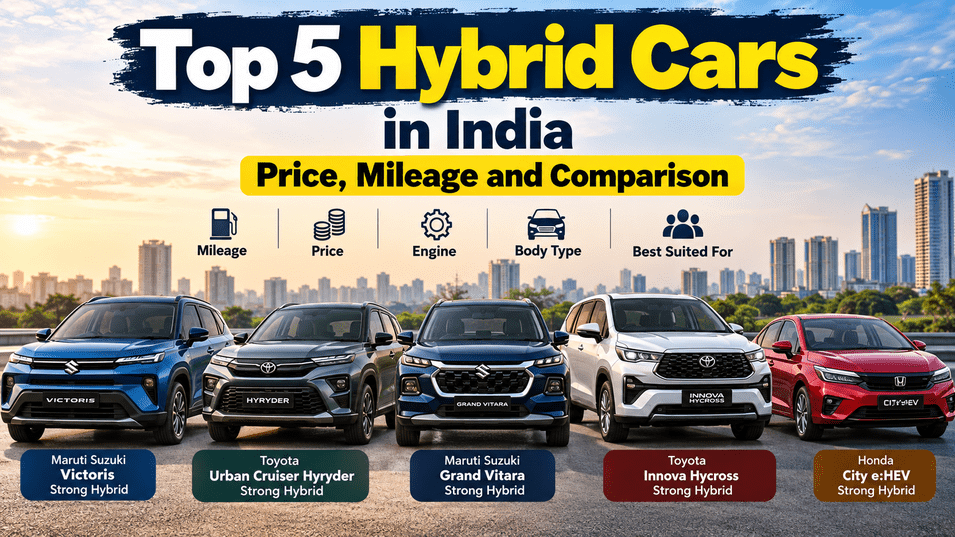
The catch is that “hybrid” is not a single shopping category. The five models in this guide solve quite different problems. The Maruti Suzuki Victoris, Toyota Urban Cruiser Hyryder and Maruti Suzuki Grand Vitara are five-seat SUVs. The Toyota Innova Hycross is a three-row MPV built for bigger families. The Honda City e:HEV keeps the hybrid conversation alive for people who still prefer a sedan.
Below, we look at each one’s claimed mileage, powertrain, features and the kind of buyer it actually serves. Just as importantly, we look at the question most brochures skip: when is the hybrid premium genuinely worth paying?
A quick note on scope. This is a selection of five strong-hybrid models, not a complete list of every hybrid sold in India. Prices and equipment change with model updates and variant revisions, so confirm the latest details with the manufacturer or an authorised dealer before you book.
Top 5 Hybrid Cars in India: Price, Mileage and Comparison
If fuel efficiency is your starting point, the table below is a sensible place to begin. Just don’t let it be the place you finish. A five-seat SUV and a three-row MPV are built for different lives, and the car with the highest certified number isn’t automatically the cheapest to own over five or eight years.
| Hybrid car | Claimed mileage | Engine | Body type | Best suited for |
|---|---|---|---|---|
| Maruti Suzuki Victoris Strong Hybrid | 28.65 km/l* | 1.5-litre petrol | SUV | Five-seat family use |
| Toyota Urban Cruiser Hyryder Strong Hybrid | 27.97 km/l | 1.5-litre petrol | SUV | City and family driving |
| Maruti Suzuki Grand Vitara Strong Hybrid | 27.97 km/l | 1.5-litre petrol | SUV | Buyers seeking an efficient SUV |
| Toyota Innova Hycross Strong Hybrid | 23.24 km/l | 2.0-litre petrol | MPV | Larger families |
| Honda City e:HEV | 27.26 km/l | 1.5-litre petrol | Sedan | Buyers who prefer sedans |
Read this before comparing the five models
Three of these cars are SUVs, but they don’t all sit at the same distance from one another. The Hyryder and Grand Vitara share closely related strong-hybrid technology, so they deserve a head-to-head look. The Victoris is a separate SUV option in the same broad space. The Innova Hycross is designed around passengers and luggage rather than compact dimensions, and the City e:HEV is the only sedan in the group.
There’s also a trap worth naming early. A better mileage figure does not guarantee a lower ownership cost. The price gap between the petrol and hybrid variants, how far you drive each year, what petrol costs where you live and the fine print of the warranty all shape the real answer.
1. Maruti Suzuki Victoris Strong Hybrid
The Victoris is Maruti Suzuki’s newest bid for the crowded mid-size SUV segment, and its strong-hybrid version is clearly pitched at families who want SUV practicality without SUV-sized fuel bills.
The hardware is familiar: a 1.5-litre petrol engine, an electric motor and an e-CVT. Depending on the situation, the system can run on electricity alone, switch to petrol, or combine both when you ask for extra performance, such as during an overtake or a climb.
The price listing used for this guide places the strong-hybrid range between ₹16.42 lakh and ₹19.98 lakh ex-showroom. Treat these as reference figures rather than a current quotation, and check variant-wise pricing before you decide.
Maruti Suzuki Victoris: Key specifications
| Specification | Details |
|---|---|
| Engine | 1,490cc petrol |
| Powertrain | Strong Hybrid |
| Transmission | e-CVT |
| Claimed mileage | 28.65 km/l* |
| Seating capacity | 5 |
| Starting strong-hybrid price | ₹16.42 lakh ex-showroom, as listed |
| Top listed strong-hybrid price | ₹19.98 lakh ex-showroom, as listed |
Mileage and prices bases on state taxes and road conditions and driver handling
Features and equipment
Depending on the variant, the Victoris can be specified with a digital instrument cluster, connected-car technology, a panoramic sunroof, a powered tailgate, ventilated seats and a 360-degree camera. Safety and driver-assistance equipment also varies across the range.
That variation is where many buyers slip up. A feature that appears in the brochure may not exist on the strong-hybrid trim you can actually afford. Check the equipment list for the exact variant, not the model as a whole.
Is the Victoris the right hybrid SUV for you?
If you want a five-seat SUV, a strong-hybrid powertrain and a tech-heavy cabin, the Victoris belongs on your shortlist. Its claimed mileage is a big part of the pitch.
The more revealing comparison, though, is inside the Victoris range itself: hybrid versus petrol. Work out how much more the hybrid costs and how much fuel it could realistically save you. Someone covering 20,000 km a year will reach a very different conclusion from someone who drives 6,000.
Suitable buyer: Families looking for a five-seat SUV, especially those who spend a lot of time in urban traffic.
2. Toyota Urban Cruiser Hyryder Strong Hybrid
Before the Hyryder, strong-hybrid technology in India mostly lived in pricier cars. Toyota’s compact SUV helped pull it into a more accessible bracket, pairing a 1.5-litre petrol engine with an electric motor and Toyota’s hybrid system.
The distinction from a mild hybrid isn’t cosmetic. The Hyryder can genuinely drive on electric power alone when conditions suit, instead of using its motor merely to nudge the petrol engine along. When you need more, engine and motor work together.
Toyota lists a certified fuel efficiency of 27.97 km/l for the strong hybrid. Its published specifications quote a maximum hybrid system output of 85 kW, with the electric motor contributing up to 59 kW and 141 Nm of torque.
Toyota Urban Cruiser Hyryder: Key specifications
| Specification | Details |
|---|---|
| Engine | 1,490cc petrol |
| Hybrid motor | 59 kW |
| Maximum system power | 85 kW |
| Hybrid motor torque | 141 Nm |
| Transmission | e-Drive |
| Claimed mileage | 27.97 km/l |
| Battery type | Lithium-ion |
| Seating capacity | 5 |
Features and equipment
Depending on the variant, the Hyryder offers a panoramic sunroof, ventilated front seats, a 360-degree camera, connected-car technology, wireless smartphone connectivity, rear AC vents and reclining rear seats.
Toyota also promotes warranty coverage for its hybrid system, and this is one area where reading the fine print pays off. Knowing that a battery warranty exists tells you very little. The duration, kilometre cap, exclusions and conditions are what decide whether it protects you.
Hyryder vs Grand Vitara: What should buyers compare?
The Hyryder’s natural rival is the Maruti Suzuki Grand Vitara Strong Hybrid. They use closely related hybrid technology, a 1.5-litre petrol engine and the same certified 27.97 km/l.
So how do you pick? Not from the mileage table, that much is certain. Compare specific variants, their equipment, current on-road prices, warranty arrangements and the service network near you. Styling and how comfortable each car feels on a test drive will reasonably tip the balance too.
Suitable buyer: Urban families who want a five-seat strong-hybrid SUV and the simplicity of ordinary petrol refuelling.
3. Maruti Suzuki Grand Vitara Strong Hybrid
The Grand Vitara is the Hyryder’s Maruti Suzuki counterpart, sold through the NEXA network. Its strong-hybrid version combines a 1.5-litre petrol engine, an electric motor and an e-CVT.
Like its Toyota sibling, it moves between electric drive, petrol drive and combined operation depending on how you’re driving. Maruti Suzuki lists a certified fuel efficiency of 27.97 km/l.
Several strong-hybrid trims are on offer, and the gap between them can be wider than buyers expect. Two versions of the same car can differ noticeably in both equipment and price, which makes a variant-by-variant comparison essential rather than optional.
Maruti Suzuki Grand Vitara: Key specifications
| Specification | Details |
|---|---|
| Engine | 1,490cc petrol |
| Powertrain | Strong Hybrid |
| Transmission | e-CVT |
| Claimed mileage | 27.97 km/l |
| Fuel tank | 45 litres |
| Seating capacity | 5 |
| Length | 4,345 mm |
| Wheelbase | 2,600 mm |
Features and equipment
Selected variants get a panoramic sunroof, head-up display, ventilated front seats, 360-degree camera, digital instrument cluster, connected-car technology, wireless charging and automatic climate control.
Because equipment varies by trim, the latest NEXA brochure is the document to trust. Maruti Suzuki has also added convenience features to selected variants over the model’s lifecycle, so older reviews may not reflect what’s in the showroom today.
Grand Vitara vs Toyota Hyryder: Is there a major mechanical difference?
Not really, at least where the strong-hybrid versions are concerned. What they share matters far more than what separates them underneath. Both run closely related 1.5-litre strong-hybrid systems with e-CVT arrangements, and both carry the same 27.97 km/l certified figure.
That shifts the decision to practical questions:
- Which variant gives you the equipment you’ll actually use?
- What does each cost on-road in your city?
- What warranty coverage applies to the hybrid battery?
- Which dealer and service network is more convenient for you?
- Which car feels better from the driver’s seat on a test drive?
When the mileage numbers are identical, choosing between them on mileage makes no sense.
Suitable buyer: Families who want a five-seat strong-hybrid SUV and prefer buying within the Maruti Suzuki NEXA range.
4. Toyota Innova Hycross Strong Hybrid
Comparing the Innova Hycross with the three compact SUVs above is a bit like comparing a family home with an apartment. It’s a larger MPV, built around three rows and designed for households that routinely move a lot of people.
The strong hybrid pairs a 2.0-litre petrol engine with Toyota’s fifth-generation hybrid system. Toyota quotes a maximum system output of 137 kW, roughly 183.7 hp, and certified fuel efficiency of 23.24 km/l.
Seven- and eight-seat configurations are available depending on the variant, with some of the higher-end hybrid trims using the seven-seat layout.
Toyota Innova Hycross: Key specifications
| Specification | Details |
|---|---|
| Engine | 1,987cc petrol |
| Powertrain | Strong Hybrid |
| Transmission | e-Drive |
| Maximum system output | 137 kW (183.7 hp) |
| Claimed mileage | 23.24 km/l |
| Fuel tank | 52 litres |
| Battery | Nickel-metal hydride (Ni-MH) |
| Seating capacity | 7 or 8, depending on variant |
Features and equipment
Selected hybrid variants come with powered second-row ottoman seats, a panoramic sunroof, ventilated front seats, connected infotainment, multi-zone climate control and a powered tailgate. Toyota Safety Sense and other driver-assistance features are available on selected trims.
These features aren’t spread evenly across the range. If you’re looking at the more expensive hybrid variants, the trim-level equipment list deserves careful attention.
Why does the Innova Hycross appeal to larger families?
The Hycross makes sense when space comes first and fuel efficiency second. That third row is the main reason to choose it over a compact SUV.
Be honest about how often you’ll fill it, though. If six or seven people regularly travel together, the cabin flexibility will matter far more than the gap between 23.24 km/l and the higher figures of the smaller hybrids. If the third row will mostly stay folded, the calculation changes.
Price is the other factor. The Hycross is a bigger, costlier vehicle, so judge it on on-road cost, intended use and annual fuel spend rather than lining it up against compact SUVs it was never meant to replace.
Suitable buyer: Larger families, frequent intercity travellers and anyone who genuinely needs a seven- or eight-seater.
5. Honda City e:HEV Strong Hybrid
With SUVs dominating showroom traffic, it’s easy to forget that plenty of buyers still want a sedan. The Honda City e:HEV is for them, wrapping Honda’s two-motor hybrid technology in one of India’s most familiar sedan nameplates.
The system combines a 1.5-litre Atkinson-cycle petrol engine with two electric motors and an intelligent power-control unit. Depending on speed and conditions, the car runs in electric drive, hybrid drive or engine drive.
Honda claims 27.26 km/l for the e:HEV, along with peak torque of 253 Nm.
Honda City e:HEV: Key specifications
| Specification | Details |
|---|---|
| Engine | 1,498cc petrol |
| Hybrid system | Two-motor e:HEV |
| Transmission | e-CVT |
| Claimed mileage | 27.26 km/l |
| Combined maximum power | 126 PS* |
| Maximum torque | 253 Nm |
| Fuel tank | 40 litres |
| Seating capacity | 5 |
Features and equipment
Depending on the version and specification, the City range includes Honda SENSING driver-assistance technology, a multi-view camera, ventilated front seats, wireless smartphone connectivity, a digital instrument display and connected convenience features.
One thing to verify before you book: features advertised across the City range don’t necessarily all come with the e:HEV. Go by the specification sheet for the exact hybrid trim.
Who should consider the Honda City e:HEV?
This is a car for people who like sitting lower, prefer the look of a sedan and still want strong-hybrid efficiency.
It suits professionals, couples and smaller families who don’t need SUV ground clearance or MPV seating. If you’ve already ruled out an SUV, the City e:HEV offers a genuinely different kind of hybrid ownership rather than a compromise.
Suitable buyer: Sedan buyers who want a petrol-electric powertrain and better efficiency than a conventional petrol sedan.
Strong Hybrid vs Mild Hybrid vs Plug-in Hybrid: What’s the Difference?
Spend enough time in showrooms and you’ll notice “hybrid” printed on cars that work in very different ways. The badge alone tells you little. A mild hybrid and a strong hybrid simply don’t offer the same electric-driving ability, and that difference shows up directly in fuel consumption.
Strong hybrid
A strong hybrid uses a petrol engine, an electric motor and a battery. In the right conditions, the motor can move the car on its own while the engine stays off.
Engine and motor can also work together. When you brake or lift off, regenerative braking recovers some of the car’s kinetic energy and stores it in the battery.
There’s no plug. The powertrain looks after battery charging while you drive.
Mild hybrid
A mild hybrid uses an electric motor or integrated starter-generator to support the petrol engine, helping with things like acceleration assistance and engine start-stop.
What it usually can’t do is drive the car meaningfully on electricity alone. That’s why lumping mild hybrids in with full hybrids leads to unrealistic mileage expectations.
Plug-in hybrid
A plug-in hybrid carries a larger battery that you charge from an external source. In return, it can typically cover longer distances on electric power than a conventional strong hybrid.
The trade-off is obvious: without regular access to charging, you lose much of the point of owning one.
Strong Hybrid vs Mild Hybrid vs Plug-in Hybrid
| Parameter | Mild Hybrid | Strong Hybrid | Plug-in Hybrid |
|---|---|---|---|
| Petrol engine | Yes | Yes | Usually |
| Electric motor | Yes | Yes | Yes |
| Electric-only driving | Generally no | Yes, under suitable conditions | Yes |
| External charging | No | No | Yes |
| Regenerative braking | Yes, depending on system | Yes | Yes |
| Main purpose | Engine assistance | Improved fuel efficiency | Electric driving with petrol backup |
All five cars in this guide are strong hybrids. Keep that in mind if you find yourself comparing their mileage with a petrol car wearing a mild-hybrid badge. It isn’t a like-for-like contest.
Are Hybrid Cars Better Than Petrol Cars or Electric Cars?
The honest answer is that it depends on where and how much you drive. A strong hybrid keeps the petrol-pump convenience you’re used to. An EV can be the smarter buy if you have dependable charging. And for someone who drives very little, a plain petrol car may still work out cheapest overall.
Here’s how the three stack up.
| Parameter | Petrol car | Strong hybrid | Electric car |
|---|---|---|---|
| Energy source | Petrol | Petrol and electricity | Electricity |
| External charging | No | No | Required |
| City efficiency | Depends on engine and traffic | Can benefit from electric assistance | Generally efficient |
| Highway convenience | Petrol refuelling | Petrol refuelling | Depends on charging access |
| Tailpipe emissions while driving | Yes | Yes | None |
| Main consideration | Purchase price and fuel costs | Hybrid price premium and fuel savings | Purchase price, charging and range |
When does a strong hybrid make sense?
A strong hybrid earns its keep when you spend plenty of time in city traffic, want lower fuel consumption without installing a charger and regularly take trips where petrol refuelling is simply easier.
It also suits drivers who want to move away from a conventional petrol engine without overhauling how they drive and refuel.
When should you consider an electric car?
An EV deserves a serious look if you have reliable home or workplace charging, your daily distances are predictable and you’re comfortable planning longer trips around charging points.
Whichever way you lean, compare the actual cost of ownership. A hybrid won’t always beat a petrol car on cost, and an EV isn’t automatically the cheapest option for every driver.
How Much Can You Save With a Hybrid Car?
Ask most buyers what worries them about hybrids and it isn’t the efficiency. It’s whether the fuel savings will ever cover the higher sticker price.
A strong-hybrid variant almost always costs more than its petrol equivalent. How quickly you earn that money back depends on three things: how far you drive, the mileage you actually achieve and what you pay for petrol.
A simple annual fuel-cost calculation helps put the gap in perspective.
Annual fuel cost = (Annual distance ÷ Mileage) × Fuel price
Here’s an illustrative example:
- Annual driving distance: 15,000 km
- Petrol price: ₹100 per litre
- Conventional petrol car mileage: 15 km/l
- Strong-hybrid mileage: 25 km/l
| Parameter | Petrol car | Strong hybrid |
|---|---|---|
| Annual distance | 15,000 km | 15,000 km |
| Assumed mileage | 15 km/l | 25 km/l |
| Annual petrol consumption | 1,000 litres | 600 litres |
| Assumed petrol price | ₹100/litre | ₹100/litre |
| Annual fuel expenditure | ₹1,00,000 | ₹60,000 |
This calculation uses assumed mileage and fuel prices. It does not represent real-world test results for any of the five cars.
On these assumptions, the hybrid burns 400 fewer litres a year, a saving of ₹40,000.
That’s a healthy number, but it’s only half the story. It leaves out the hybrid’s higher purchase price, financing, insurance, maintenance and resale value. And your real-world mileage may not match the assumptions at all.
How to calculate the hybrid break-even period
Once you know how much extra the hybrid variant costs, you can estimate how long fuel savings would take to recover it.
Break-even period = Additional purchase cost ÷ Annual fuel savings
Say a hybrid costs ₹2 lakh more than the petrol version and saves you ₹40,000 a year on fuel. The simple break-even point is five years. If you typically change cars every three, that changes the picture considerably.
Treat this as a starting point. For a sharper estimate, use the real mileage of the two specific variants, your local petrol price and the ownership costs for the models you’re considering.
What Should You Check Before Buying a Hybrid Car in India?
A strong mileage claim can make any hybrid look compelling on paper. Ownership, however, happens off paper. These are the checks worth making before you hand over a booking amount.
Compare the hybrid variant’s purchase price
Line up the strong hybrid against the closest petrol variant and look at what else changes. Often the hybrid trim also carries extra equipment, which accounts for part of the price gap.
Separating the two stops you from charging the entire premium to the hybrid technology.
Calculate how much you drive each year
Your annual distance drives your potential savings more than any other factor. A 20,000 km-a-year commuter and a weekend-only driver are effectively doing different maths.
Use your real driving pattern. It’s tempting to assume you’ll drive more once the car is cheaper to run, but that assumption tends to flatter the numbers.
Understand city and highway mileage
Strong hybrids get much of their advantage from electric assistance and regenerative braking, and stop-start city traffic gives those systems plenty to work with. Even so, no two urban commutes will deliver identical results.
Speed, gradients, air-conditioning, passenger and luggage load, and driving style all affect consumption. Certified mileage is a useful yardstick for comparing cars under standardised conditions. It is not a promise about your daily figures.
Read the hybrid battery warranty carefully
The battery warranty deserves more attention than it usually gets in the showroom. Before booking, ask the manufacturer or dealer about:
- Warranty duration and kilometre limit
- Conditions for extended coverage
- Exclusions and maintenance requirements
- Whether the warranty transfers to the next owner
- Battery inspection and replacement procedures
Terms differ across manufacturers and models. Never assume a battery warranty covers every possible repair or replacement.
Check service and maintenance support
Find out the scheduled service requirements and how many authorised service centres exist where you live and where you regularly travel. Ask, too, whether the manufacturer requires any specific hybrid-system inspections.
A hybrid battery and electric motor don’t automatically make a car expensive to maintain. They do make it worth understanding the service arrangements before you’re locked in.
Make sure the car suits your family
The cleverest powertrain in the world won’t fix a car that doesn’t fit your everyday life.
Check rear-seat comfort, boot space, ground clearance and luggage capacity. If the Innova Hycross is on your list, actually sit in the third row rather than trusting the seat count in the brochure.
With a compact SUV, ease of parking and day-to-day manoeuvrability may matter more. Either way, take the test drive with the people who will ride in the car most often.
Which Hybrid Car Should You Consider?
No single car here is the obvious answer for everyone. Body style, cabin layout and ownership proposition differ too much for that.
| Buyer requirement | Model to consider | Why it deserves a look |
|---|---|---|
| Five-seat hybrid SUV | Maruti Suzuki Victoris | Strong-hybrid SUV format |
| Toyota strong-hybrid SUV | Urban Cruiser Hyryder | Toyota hybrid system and SUV body style |
| Maruti strong-hybrid SUV | Grand Vitara | Strong-hybrid powertrain in the NEXA SUV range |
| Larger family vehicle | Innova Hycross | Three-row MPV layout |
| Hybrid sedan | Honda City e:HEV | Sedan format with two-motor hybrid technology |
Use this to narrow your shortlist, not to make the final call. That decision should follow a proper look at current variant prices, warranty terms, equipment and how each car feels on the road.
Is a Hybrid Car Worth Buying in India in 2026?
Strong hybrids sit in an interesting spot in India’s car market. They deliver a real share of electric efficiency without asking owners to plan their lives around charging stations.
For anyone who values the simplicity of petrol refuelling, that’s a meaningful advantage. And as these five models show, the technology now spans compact SUVs, a family MPV and a sedan, which means buyers no longer have to pick a body style they don’t want just to get a hybrid.
Still, mileage shouldn’t make the decision on its own. A hybrid that costs considerably more than its petrol twin can take years to pay off, especially for low-mileage drivers. High-mileage drivers, by contrast, are the ones most likely to see the savings add up.
Before you buy, compare exact variants, get current on-road quotations, read the battery warranty properly and estimate your fuel costs over the years you expect to keep the car.
A strong hybrid isn’t the right answer for every buyer. But if your driving pattern, budget and practical needs line up with what it does well, it’s one of the most sensible middle paths between a conventional petrol car and a fully electric one.
Keep on touch with Indus ev for ev car and bike related updates.
Frequently Asked Questions About Hybrid Cars in India
Which are the top 5 hybrid cars in India in 2026?
The five strong-hybrid models covered in this guide are the Maruti Suzuki Victoris, Toyota Urban Cruiser Hyryder, Maruti Suzuki Grand Vitara, Toyota Innova Hycross and Honda City e:HEV. Between them, they cover three body types: SUVs, an MPV and a sedan.
Which hybrid car has the highest mileage among these five models?
The Maruti Suzuki Victoris is listed at 28.65 km/l in the specifications used for this guide, though this should be confirmed against the latest manufacturer brochure. The Hyryder and Grand Vitara are listed at 27.97 km/l, the Honda City e:HEV at 27.26 km/l and the Innova Hycross at 23.24 km/l.
All are manufacturer-claimed or certified figures, not guaranteed real-world mileage.
Do strong-hybrid cars need external charging?
No. Conventional strong hybrids never need to be plugged in. Their batteries are replenished through regenerative braking and the hybrid powertrain itself.
What is the difference between a strong hybrid and a mild hybrid?
A strong hybrid can drive on electric power alone under suitable conditions. A mild hybrid mainly uses its motor to assist the petrol engine and normally can’t offer meaningful electric-only driving.
Which hybrid car is suitable for a large family?
The Toyota Innova Hycross is the three-row MPV in this group. With seven- and eight-seat configurations depending on the variant, it suits families who regularly travel with several passengers.
How long does a hybrid car battery last?
There’s no single lifespan that applies to every hybrid battery. It depends on the vehicle, how it’s used, the climate and maintenance. Rather than relying on a general estimate, check the manufacturer’s warranty duration, kilometre limit, exclusions and replacement conditions.
Are hybrid cars cheaper to maintain than petrol cars?
Not necessarily. A hybrid carries extra electrical components, and its petrol engine still needs regular servicing. Real maintenance costs depend on the model, service schedule, parts availability and warranty coverage.
Is a hybrid car better than an electric car?
It comes down to your driving needs. A strong hybrid needs no external charging and keeps petrol refuelling convenience. An EV may suit someone with reliable charging and predictable daily travel. Compare the purchase price and running costs of specific vehicles instead of treating either technology as universally better.
Are strong-hybrid cars suitable for highway driving?
Yes. Strong hybrids handle highway journeys comfortably, and the petrol engine means refuelling works just as it does in any conventional car. Actual efficiency will depend on speed, road conditions, load and driving style.
Is a strong hybrid worth the extra price?
That depends on the price gap between the hybrid and petrol variants, how far you drive each year, fuel prices and how long you plan to keep the car. Estimate your likely annual fuel savings and weigh them against the extra purchase cost before deciding.