
Two electric scooters can carry the same 3.1kWh battery and still be about ₹30,000 apart on the price list. Ola’s S1 Z 3.1kWh has an introductory price of ₹79,999. TVS lists the Orbiter V2, also rated at 3.1kWh, at ₹1,09,830.
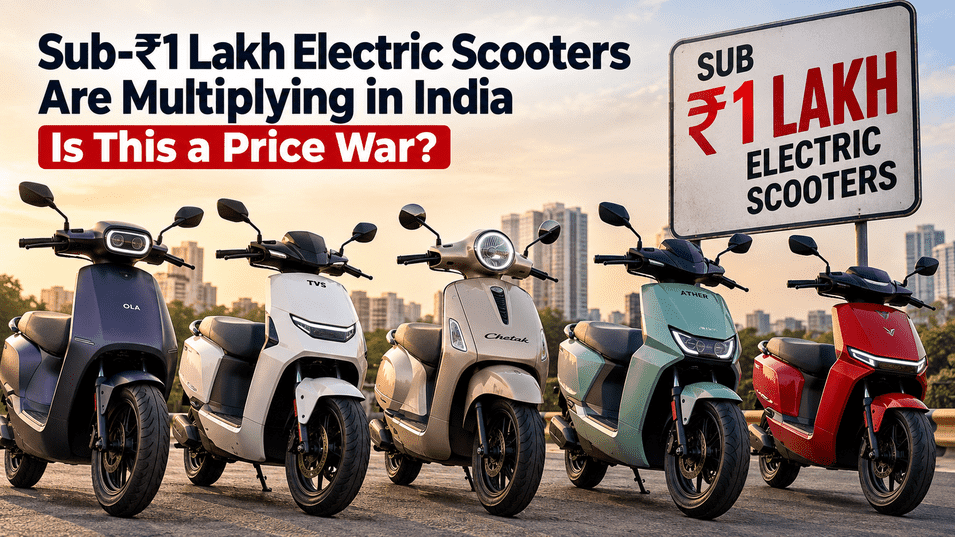
Both belong to the same new part of India’s EV market: scooters priced near or below ₹1 lakh. Ola, TVS, Bajaj and Ather all sell something there now. A year or two ago, choosing electric often meant paying a clear premium over a petrol scooter. That gap is closing, and the obvious question is whether manufacturers have started a price war.
The short answer is not yet, or at least not in the usual sense. Prices are falling at the entry level, but each brand is getting there differently. Some use smaller batteries, some use introductory prices, and some quote prices after government incentives have been deducted. A buyer comparing only headline prices will miss most of what separates these scooters.
Sales are rising while prices come down
Demand is growing alongside the cheaper models. According to FADA data reported by automotive publications, electric two-wheeler retail sales reached 1,83,204 units in August 2026. That is 67.05% higher than the 1,09,673 units sold in August 2025.
This matters because falling prices do not look like a response to weak demand. They look more like a fight for a fast-growing group of buyers who were not willing to pay ₹1.2–1.5 lakh for their first EV.
What ₹80,000 to ₹1 lakh buys you today
| Scooter | Listed price | Battery | Claimed range | Notes |
|---|---|---|---|---|
| Ola S1 Z | ₹79,999 (introductory) | 3.1kWh | 179km (IDC) | 70kmph top speed |
| Ola S1 Z | ₹99,999 (introductory) | 5.1kWh | 301km (IDC) | — |
| Ola S1 X | ₹84,999 ex-showroom | 2kWh | — | ₹59,999 shown on an offer page after discount |
| Bajaj Chetak C25 | ₹91,399 ex-showroom, Bengaluru | 2.5kWh | Up to 113km | 55kmph top speed |
| TVS Orbiter V1 | ₹99,900 effective ex-showroom | 1.8kWh | Lower than V2 | Price includes PM E-DRIVE benefit |
| TVS Orbiter V2 | ₹1,09,830 | 3.1kWh | 158km (IDC) | — |
| Ather Konarc | ₹99,999 (introductory) | — | 200km (IDC) | 0–80% home charge in two hours on specified setup |
Every range figure in this table is a manufacturer claim based on a certified test cycle. None of them is a real-world figure. Riders who carry a pillion, ride fast on the flyover or commute in summer heat should expect to get less.
Ola is the most aggressive on price
Ola has set the lowest entry point among the major EV makers. The S1 Z’s ₹79,999 figure is for the 3.1kWh version, rated at 179km IDC with a 70kmph top speed. The 5.1kWh version, at an introductory ₹99,999, claims 301km.
The S1 X shows how much the wording on a price matters. Ola’s main listing puts the 2kWh model at ₹84,999 ex-showroom. A separate offer page shows ₹59,999 after a discount. The second number is promotional, and anyone budgeting for a purchase should treat ₹84,999 as the reference price until the dealer confirms otherwise.
TVS enters with an incentive-inclusive price
TVS launched the Orbiter in August 2025 at ₹99,900 ex-showroom. That price included the PM E-DRIVE benefit applicable at the time. The Orbiter V1 is still listed at that effective price. It uses a 1.8kWh battery, which is a little over half the capacity of the V2’s 3.1kWh pack.
This is where headline prices can mislead. The Orbiter V1 and the Konarc are within ₹99 of each other on paper, but a smaller battery generally means more frequent charging. For a rider with a 15km round trip, that may not matter much. For someone covering 50km a day across a large city, it will show up every week.
Bajaj uses a smaller battery and a limited offer
The Chetak C25 went on sale in January 2026 at ₹91,399 ex-showroom in Bengaluru. It has a 2.5kWh battery, a claimed range of up to 113km and a top speed of 55kmph. That top speed suits dense urban traffic. It will feel limited on faster arterial roads and ring roads.
Bajaj also offered ₹4,299 off to the first 10,000 buyers, bringing the effective price to ₹87,100. That offer was temporary. It reduced the entry cost without permanently changing the list price, and several brands are using the same approach.
Ather joins the same bracket
Ather’s Konarc carries an introductory price of ₹99,999, with a claimed 200km IDC range. Ather says it can charge from 0 to 80% at home in two hours using its specified charging setup. That detail deserves attention. How long a scooter takes to charge overnight matters less than whether it can recover quickly during the day, for example between a morning commute and an evening errand.
With Ather in this price band, buyers can compare four established EV names without moving up to the next price bracket.
Petrol scooters still cost less to buy
The upfront gap has narrowed a lot, but it still exists. Hero MotoCorp lists the Pleasure+ XTEC at roughly ₹70,000–₹78,000 ex-showroom, depending on variant and location. Even Ola’s ₹79,999 S1 Z costs slightly more than that.
A like-for-like price comparison also misses running costs. A petrol scooter’s cost of ownership depends on mileage and fuel prices over several years. An EV’s depends on electricity, insurance, financing, maintenance and whether there is a practical place to charge it. An apartment resident without a parking-spot socket faces a different calculation from someone with a garage wall to plug into, and no ex-showroom price shows that.
Incentives make the listed prices harder to compare
Government support affects how prices are presented. The PM E-DRIVE scheme gives incentives to eligible electric two-wheelers, and an August 2026 amendment from the Ministry of Heavy Industries extended the scheme’s terminal date for e-2Ws to March 31, 2028.
As a result, some brands advertise an effective price after the incentive, while others list a figure that may not reflect it in the same way. TVS clearly states that the Orbiter’s price is an effective ex-showroom figure after the PM E-DRIVE benefit. When prices are presented differently across brands, the on-road quotation from the dealer is the only reliable way to compare them.
Established two-wheeler makers now lead EV sales
The August retail figures show that this is no longer mainly a contest among EV scooter startups:
- TVS: 48,938 units
- Bajaj Auto: 41,114 units
- Ather Energy: 28,757 units
- Ola Electric: 13,852 units
These are brand-level electric two-wheeler figures, not model-level sales, so they do not show how many S1 Zs or Chetak C25s were sold.
According to FADA data reported by Autocar India, TVS, Bajaj, Ather and Hero MotoCorp’s Vida together accounted for around three-quarters of electric two-wheeler sales in August. TVS and Bajaj bring large dealer and service networks built over decades of selling petrol scooters. For a first-time EV buyer in a smaller city, having a service centre nearby may matter more than a ₹10,000 price difference.
This also helps explain Ola’s pricing. Ola leads on low prices but is fourth by volume, so aggressive pricing is one of the main ways it can compete with companies that already have extensive dealer and service networks.
A price war, or competition on value?
“Price war” suggests companies cutting prices on comparable products until margins run out. That is not what is happening here.
There is clearly more price competition. Several brands now have products between roughly ₹80,000 and ₹1 lakh, and promotional offers are reducing effective prices further. However, the products at those prices differ a lot. Batteries range from 1.8kWh to 5.1kWh. Claimed ranges vary from about 113km to 301km. Top speeds and features also differ. Manufacturers are building different products for different price points, not selling the same product more cheaply.
The ₹79,999 S1 Z, ₹91,399 Chetak C25, ₹99,900 Orbiter and ₹99,999 Konarc sit in the same broad price range but are not equivalent products. The evidence so far points to increasing competition on value rather than an industry-wide price war.
For buyers, that means there is more choice below ₹1 lakh than before, but comparing options takes more work. At a similar price, the first things to check are battery capacity, whether the price is permanent or introductory, and how close the nearest service centre is.