From a Lost Brand to Highest Sales – Bajaj Chetak Sales in 2026, 3.05 Lakh Units in Eight Months

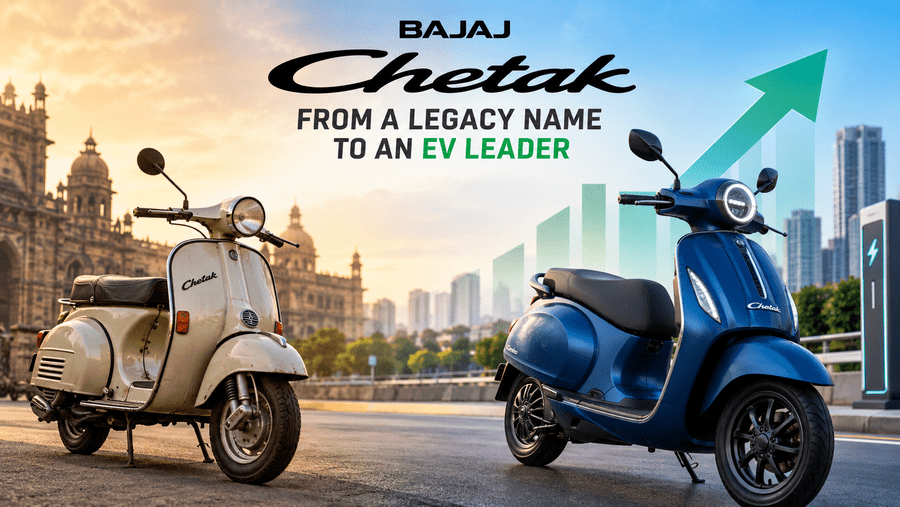
In 1972, the Chetak was a petrol scooter. In the first eight months of 2026, the Chetak name was on 3,05,226 electric scooters, according to Vahan-based industry data. That is 69% more than the 1,80,209 units recorded in the same period of 2025. The figure puts Bajaj close to the top of India’s electric two-wheeler market.
Bajaj is not first, however. TVS registered 3,56,579 electric two-wheelers over the same January–August period, and Ather recorded 2,29,099. Across a market of about 13.6 lakh units in the same dataset, Bajaj’s share was roughly 22%.
What the growth figures show
Bajaj added 1,25,017 units compared with January–August 2025, a 69.4% increase, which matches the reported 69% figure.
The growth has also been steady across the year. Monthly volume peaked in March at 47,753 units. Sales crossed 40,000 again in June, July and August, with August at 41,019 units. Four months above 40,000 in the first eight months suggests sustained demand rather than a single strong month.
These are registration-based figures. Bajaj’s own reports use billing and retail numbers, and those will not always match Vahan data for the same period.
Why the 235% August growth figure is misleading
Chetak’s August 2026 volume was 235% higher than August 2025. That comparison is distorted by a very weak base month.
In August 2025, Chetak supply was affected by a shortage of rare-earth magnets. Bajaj said at the time that deliveries had been scaled back because of the component shortage, and that production and shipments resumed on August 20, 2025. The following year’s August figure was therefore compared against a month that lost production days.
The January-August comparison is more reliable. A 69% increase over eight months cannot be explained by one weak month.
The C Series added cheaper entry points
A large part of Bajaj’s strategy has been adding models at different price points.
The Chetak C25 launched in January 2026 at an introductory ex-showroom price of ₹91,399. It uses a 2.5kWh battery with a company-certified range of up to 113km, and Bajaj says it charges to 80% in 2.25 hours on the specified charger. For a large share of urban commuters, whose daily riding stays well within that range, this is a practical specification.
Bajaj offered an early-bird benefit of ₹4,299 to the first 10,000 buyers, reducing the effective price to ₹87,100. That was a limited-time offer and not the standard price.
In April, Bajaj reorganised the lineup into three series:
- C25: 2.5kWh battery
- C30: 3.0kWh battery
- C35: 3.5kWh battery
Each series has different equipment levels. With three battery sizes, Bajaj can offer a lower entry price without giving up the buyer who wants more range, and it no longer relies on a single configuration. That gives the Chetak more flexibility against rivals that are also cutting entry prices.
The Chetak name helps, but only partly explains the sales
When Bajaj revived the Chetak as an electric scooter in 2019, it started with brand recognition that most EV startups did not have. In a 2022 announcement, the company described its Akurdi plant as the site where the original Chetak was built in the 1970s. Parents who owned a Chetak were a ready audience for an electric one.
Brand recognition alone would not have produced these numbers, though. Buyers still need a competitive price, reliable supply, a dealer to buy from and a workshop for repairs. The magnet shortage in 2025 showed how quickly supply problems can hold back sales, whatever the strength of the brand.
The longer-term figures show continued investment. Bajaj’s FY2026 annual report says the Chetak crossed 7 lakh cumulative units since launch and achieved its highest billing and retail volumes during the year. The company reported domestic Chetak sales of 3,02,674 units in FY2026, compared with 2,60,033 in FY2025. These are company-reported financial-year numbers. They cover a different period from the Vahan calendar-year figures, so the two sets should not be combined.
How Bajaj compares with TVS and Ather
| Brand | Jan–Aug 2026 | Year-on-year growth |
|---|---|---|
| TVS | 3,56,579 | 77% |
| Bajaj | 3,05,226 | 69% |
| Ather | 2,29,099 | 83% |
Ather grew fastest, from a smaller base, while TVS sold the most. Bajaj is second by volume and growing strongly, but it has not closed the gap with TVS.
The results do not support the idea that EV startups would displace established two-wheeler companies. TVS and Bajaj, the two largest sellers in this dataset, both still sell large numbers of petrol vehicles and can use existing factories, suppliers, dealers and service networks for their electric scooters. EV-only companies now have to compete with those networks as well as on product.
For buyers, particularly outside the metros, more choice comes from companies whose service centres are likely to be nearby. That can matter more than a small difference in claimed range.
The harder test comes in 2027
The Chetak has become one of India’s highest-volume electric scooters. The next test is whether Bajaj can keep growing once it is no longer compared against a supply-hit 2025. In 2027, Bajaj will be measured against its own strong 2026 figures. By then the C25, C30 and C35 lineup will have been on sale for a full year, and TVS and Ather are not slowing down.