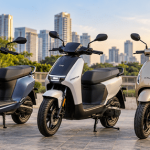

Ola Electric’s latest mass-market scooter is also a test of a bigger idea: can locally developed LFP battery technology make electric scooters cheaper, safer and longer-lasting without giving up too much performance?
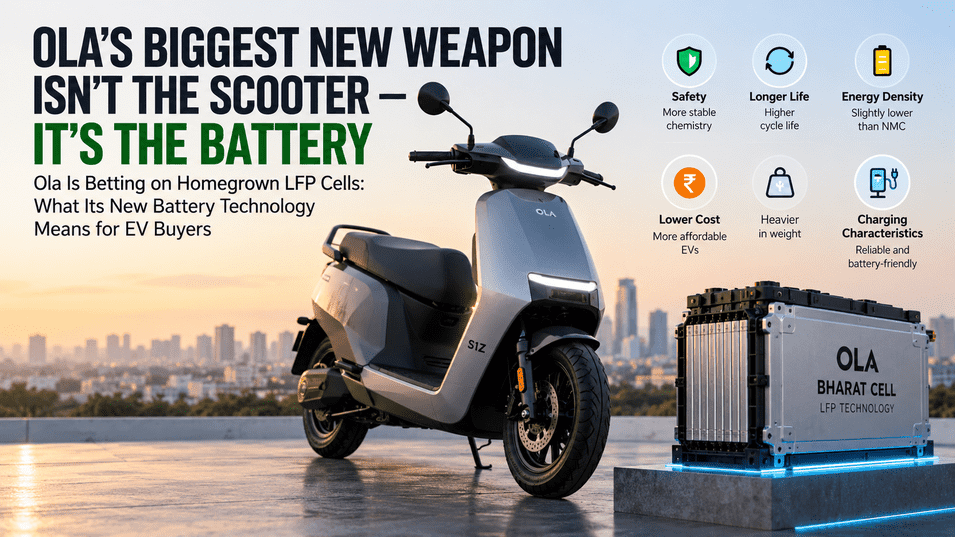
The company’s answer is the new S1Z, which brings Ola’s indigenously developed Bharat Cell LFP technology to its most accessible scooter range. Ola says the technology was developed at its Battery Innovation Centre and is being manufactured at its Gigafactory in India.
That makes the battery more important than the scooter itself.
Ola already uses its 4680 Bharat Cell technology in higher-performance products, but that platform uses NMC chemistry. In its investor materials, Ola describes NMC as its “performance track” and LFP as its “scale track”, with LFP intended for affordable EVs and energy-storage applications.
For an Indian scooter buyer, that chemistry choice has several practical consequences.
Ola S1Z: What exactly is being offered?
The S1Z is available with two battery capacities:
| Specification | S1Z 3.1 kWh | S1Z 5.1 kWh |
|---|---|---|
| Battery chemistry | LFP | LFP |
| Battery capacity | 3.1 kWh | 5.1 kWh |
| Claimed IDC range | Up to 179 km | Up to 301 km |
| Introductory ex-showroom price | ₹79,999 | ₹99,999 |
| Scheduled deliveries | December 2026 | March 2027 |
Ola quotes the range figures under the IDC test cycle. They should not be interpreted as the distance every owner will achieve in normal Indian traffic. Actual range will vary with speed, traffic, rider weight, temperature, tyre pressure, riding style and use of electrical systems.
The bigger story, however, sits inside the battery pack.
LFP vs NMC: Why does the chemistry matter?
LFP stands for lithium iron phosphate, while NMC stands for nickel manganese cobalt.
Both are lithium-ion battery chemistries, but their cathode materials give them different characteristics.
| Factor | LFP | NMC |
|---|---|---|
| Energy density | Generally lower | Generally higher |
| Thermal stability | Generally higher | Generally lower than LFP |
| Cycle life | Generally longer | Generally shorter |
| Material cost | Generally lower | Generally higher |
| Weight for same energy | Usually higher | Usually lower |
| High-power performance | Depends on cell design | Strong performance potential |
| Suitability | Cost-sensitive, high-cycle applications | Performance/range-focused applications |
Research comparing the two chemistries consistently identifies LFP’s advantages in thermal stability, cycle life and cost, while NMC generally offers higher energy density.
But those advantages only become useful when translated into everyday riding.
1. Safety: LFP has an important advantage
One of LFP’s biggest technical advantages is its chemical and thermal stability.
LFP’s phosphate-based cathode structure is more resistant to thermal decomposition than many nickel-rich chemistries. That doesn’t make an LFP battery immune to fire or damage, no lithium-ion battery should be described as completely fireproof, but it can provide a greater safety margin at the cell level.
For an Indian electric scooter, this matters because the battery can encounter demanding conditions: high ambient temperatures, heavy traffic, frequent charging and sometimes inconsistent charging environments.
Ola itself highlights the thermal stability of its LFP cell and says the S1Z’s battery is designed for Indian conditions. Those statements should still be treated as manufacturer claims until long-term independent field data becomes available.
2. Battery life: This is where LFP becomes interesting
LFP is generally capable of more charge-discharge cycles than NMC.
The U.S. Department of Energy’s energy-storage assessment, for example, used a representative cycle-life assumption of around 2,000 cycles for LFP compared with 1,200 cycles for NMC under the specified test conditions. Actual life varies substantially with cell design, temperature, depth of discharge, charging behaviour and operating conditions.
Ola’s own 46100 LFP cell has been described as having a development pathway toward more than 4,000 charge-discharge cycles.
The S1Z website goes further, claiming that LFP can give the battery a life of more than 15 years.
For buyers, the important distinction is this:
A long theoretical cycle life does not automatically mean a scooter battery will retain its original capacity for 15 years.
Battery ageing depends on temperature, charging patterns, depth of discharge, storage conditions and battery-management software as well.
Still, the chemistry gives Ola a useful foundation for a scooter expected to see frequent daily charging.
3. The trade-off: LFP gives up some energy density
There is no free lunch in battery chemistry.
NMC generally provides higher energy density than LFP. In simple terms, an NMC pack can store more energy for a given mass or volume.
LFP generally needs more material to store the same amount of energy.
For a car, that can become a major packaging issue. For a scooter, weight also matters because it affects acceleration, handling and efficiency.
But this is where Ola’s mass-market strategy becomes interesting.
The company isn’t trying to use LFP primarily to create the lightest possible performance scooter. It is using the chemistry to target a more cost-sensitive segment.
Ola’s own investor presentation explicitly describes LFP as its scale track, while NMC is positioned for performance-oriented products.
4. Cost could be the biggest benefit for buyers
LFP does not depend on nickel and cobalt in its cathode chemistry.
That can provide a cost advantage, particularly for vehicles where battery price has a major influence on the final vehicle price.
Ola says developing and manufacturing its Bharat Cell LFP technology in-house has helped it reduce battery costs and bring the chemistry to the mass market.
This is also where local manufacturing becomes strategically important.
Ola isn’t simply buying an LFP pack from a supplier and putting it into the S1Z. The company’s stated strategy is to move further down the battery value chain, from cell development and manufacturing to battery packs and the vehicle itself.
If Ola can improve manufacturing yields and scale production, the benefit could eventually extend beyond one scooter.
5. What about charging?
This is an area where buyers should be careful with simplistic comparisons.
It would be incorrect to say that all LFP batteries charge faster or slower than all NMC batteries.
Charging performance depends on the particular cell, battery pack, thermal-management system, battery-management software, charger and charging curve.
LFP’s strengths are more closely associated with safety, longevity and cost than with automatically delivering faster charging.
There is, however, growing research into the effects of repeated fast charging on different lithium-ion chemistries. One 2025 study found that degradation from frequent fast charging varies significantly by chemistry and charging conditions.
For an S1Z owner, therefore, the practical question is not simply “LFP or NMC?” It is what charging hardware and battery-management strategy Ola has engineered around this particular cell.
6. What does this mean for an Indian scooter buyer?
For a typical city commuter, LFP’s characteristics line up reasonably well with the job an affordable electric scooter needs to perform.
Consider the use case.
A rider may charge the scooter frequently, keep it for several years and place more importance on predictable ownership costs than on maximum acceleration or the lowest possible battery weight.
That is almost the textbook environment in which LFP becomes attractive.
For daily city commuting
The longer cycle-life potential can be valuable for riders who charge frequently.
The chemistry’s thermal stability is another useful attribute in India’s demanding climate, although the entire battery-pack design remains important.
For buyers keeping the scooter for many years
LFP’s durability potential is particularly relevant.
If the battery retains useful capacity for longer, the owner may be able to postpone or avoid a costly battery replacement. But S1Z-specific long-term degradation data is not available yet.
For performance-focused riders
NMC still has an important role.
Higher energy density can help manufacturers create lighter packs or extract more energy from a given package. That’s one reason Ola continues to position NMC for performance-oriented products.
For price-sensitive buyers
This may be where the S1Z’s battery strategy matters most.
The OLA S1Z 3.1 kWh version starts at ₹79,999 ex-showroom, while the 5.1 kWh version starts at ₹99,999 ex-showroom. If Ola can maintain battery costs at scale, LFP could help the company put larger energy storage into more affordable scooters.
The bigger Ola strategy is actually about chemistry diversification
The S1Z should not be viewed as Ola abandoning NMC.
The company’s roadmap points in the opposite direction.
Ola is developing multiple battery chemistries and formats, with NMC positioned for performance-oriented mobility and LFP for mass-market mobility and energy storage. Its annual report also identifies LFP, NMC, LMFP, sodium and solid-state technologies as part of its broader technology roadmap.
That could become an important competitive advantage if Ola succeeds in matching each chemistry to the right vehicle.
A ₹80,000 scooter doesn’t necessarily need the same battery chemistry as a high-performance electric motorcycle.
That’s the key point.
What buyers should watch next
The S1Z will provide the first meaningful test of whether Ola’s LFP strategy works at mass-market scale.
The important metrics won’t just be the advertised range.
Watch for:
- Real-world range after regular usage
- Battery capacity retention over several years
- Charging performance
- Performance in India’s summer conditions
- Production quality and consistency
- Replacement battery pricing
- Serviceability
- Warranty experience
- Manufacturing scale and battery cost reduction
The company has already crossed an important development milestone: its indigenous 46100 LFP cell received BIS certification after undergoing a range of safety and qualification tests.
But certification is not the same thing as proving long-term ownership performance.
That part will have to be demonstrated on Indian roads.
Indus ev’s Take
The most important thing about the S1Z may not be its ₹79,999 starting price or its 179 km IDC range. It is the chemistry underneath it.
Ola is effectively using LFP to make a strategic trade: give up some energy density in exchange for potentially lower cost, greater thermal stability and longer cycle life.
For an affordable electric scooter, that can make considerable sense.
The real test, however, starts after the launch headlines disappear. If Ola can manufacture its LFP cells consistently, keep costs under control and demonstrate strong battery retention over years of everyday Indian use, the S1Z could become more than another low-cost electric scooter.
It could demonstrate whether locally manufactured LFP cells can become the foundation of India’s next mass-market EV wave.
Stay tuned with Indus ev for more updated.