

Three years ago, if you’d asked anyone in the Indian auto industry which company owned the electric two-wheeler market, there was only one answer: Ola Electric. Today that answer is wrong, and August’s registration numbers make it hard to argue otherwise.
India registered 1,80,569 electric two-wheelers last month, a 65% jump over August last year, according to VAHAN registration data compiled by Nuvama Institutional Equities. That growth rate isn’t really the story anymore, strong year-on-year numbers have become routine for this segment. What’s changed is who’s behind them. TVS Motor Company, Bajaj Auto, Ather Energy and Hero’s Vida brand together accounted for 76.2% of every electric scooter and motorcycle registered in August. Ola, the company that built its entire identity on disrupting this market, has been pushed down to fifth place with just 7.7% share, and its sales are still falling, down 29% year-on-year even as everyone around it grows.
What actually happened in August
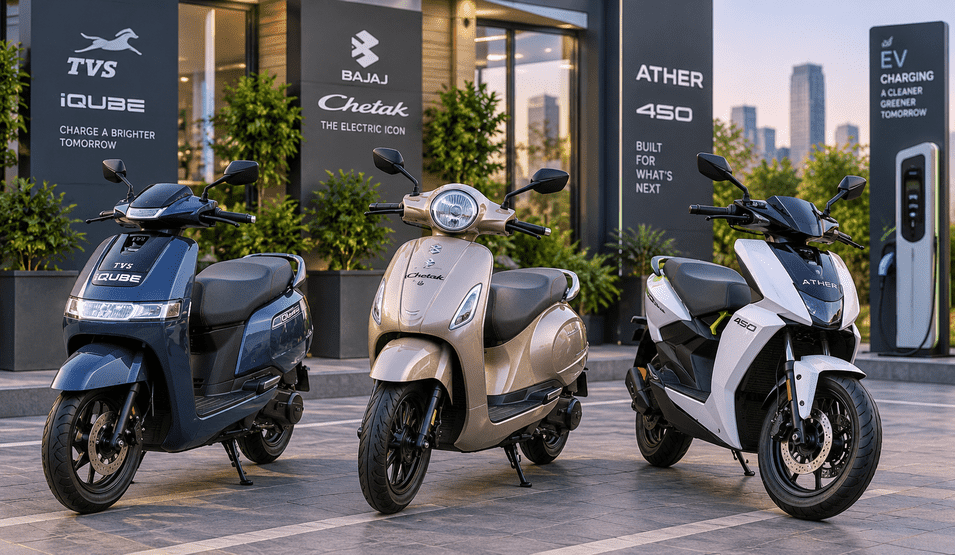
TVS held the top spot again, registering 48,873 units, up 91% from a year ago and good for 27.1% of the market. That’s a solid, expected result from the current leader. The bigger surprise is Bajaj Auto, whose registrations more than tripled year-on-year to 41,018 units, a growth rate almost nobody in the segment can match right now, pushing its share to 22.7%. Put those two together and TVS and Bajaj alone now account for roughly half of every electric two-wheeler sold in the country. That’s not a market with two players slightly ahead of the pack; that’s a market being run by two companies.
Ather Energy added 28,707 units, up 49% YoY, holding 15.9% share. Hero’s Vida brand registered 18,977 units, up 38%, for around 10.5%. And then there’s Ola, at 13,849 units, the only major brand on the list whose numbers went backward while the rest of the market expanded around it.
| Brand | Aug 2026 Registrations | YoY Change | Market Share |
|---|---|---|---|
| TVS | 48,873 | +91% | 27.1% |
| Bajaj | 41,018 | +235%* | 22.7% |
| Ather | 28,707 | +49% | 15.9% |
| Hero Vida | 18,977 | +38% | ~10.5% |
| Ola Electric | 13,849 | -29% | 7.7% |
*Autocar Professional describes Bajaj’s growth simply as “more than tripled”; a separate tracker, AutoPunditz, puts the exact figure closer to +236%, working off the same underlying VAHAN dataset. The small gap comes down to how each outlet handles provisional versus revised registration data, not a real disagreement about what happened.
This isn’t a one-month story, either, which is what makes it worth paying attention to. Stretch the timeframe out to the first eight months of 2026, and TVS, Bajaj, Ather and Vida have sold 10,38,973 electric two-wheelers combined, already more than their entire combined 2025 total of 9,22,824 units, with a third of the year still left to run. That’s 84% growth over the same period last year, and these four brands have held roughly 76% of the year-to-date market throughout, which tells you August wasn’t an anomaly. It’s the new normal.
What this means if you’re actually shopping for one
Here’s where the story gets practical for buyers rather than just interesting for industry-watchers. TVS and Bajaj aren’t winning because their scooters are dramatically better on paper, they’re winning because they’re leaning on infrastructure the startups never had. Hundreds of existing dealerships built over decades of selling petrol two-wheelers. Service networks that already reach small towns, not just metro hubs. Financing relationships with banks that a five-year-old EV startup simply can’t replicate overnight. Bajaj in particular has priced the Chetak aggressively into mass-market territory, and its growth rate this year backs up that strategy. Ather has stuck to more premium positioning and is still growing at a healthy, sustainable pace, proof there’s room in this market for more than one playbook.
Ola’s decline is more instructive than most sales slumps, mainly because the company hasn’t tried to spin it. Founder and CEO Bhavish Agarwal has said plainly, in comments reported earlier this year, that “we do have a service challenge which we are working through that has impacted brand trust, and hence sales are down.” That’s about as direct an admission as you’ll get from a listed company’s chief executive. Ola has also been shrinking its retail footprint hard, from a peak of nearly 4,000 outlets down to a reported target of around 550, as part of a pivot toward a more conventional dealer-led model. If you’re weighing an EV purchase right now, that’s a genuinely useful data point: it’s worth asking what after-sales support actually looks like for a given brand in your city, not just what the showroom promises on day one, but what happens eighteen months later when the battery needs a checkup.
Why the competitive order has flipped
Three years ago, Ola’s advantage was structural, it had no legacy petrol-scooter business to protect, no old-guard dealer politics to manage, nothing holding it back from moving fast. TVS, Bajaj and Hero have essentially neutralized that advantage by turning their own scale into the new edge: manufacturing capacity, distribution reach, and decades of brand trust that a newer company simply can’t manufacture on a marketing budget. Ather is the one EV-native brand that’s kept pace through all of this, and it’s done it the boring way, steady growth, consistent execution, rather than the explosive-then-collapsing trajectory Ola went through. That contrast alone says something about which approach actually holds up over time.
What happens from here
None of the five companies has a major new EV two-wheeler launch on the calendar right now, so near-term movement will likely keep tracking existing model pricing rather than any fresh entrant shaking things up. Ola says it’s investing in expanding service infrastructure and diversifying, its Roadster electric motorcycle line and in-house Bharat Battery development are both part of that pivot, though the company hasn’t put a specific timeline on when it expects share to recover, and it would be speculation to guess one for them. Extrapolate the pace of the last eight months forward, and the overall EV two-wheeler market looks on track to approach roughly 20 lakh units for the full year. Worth flagging: that’s a rough projection based on year-to-date volume, not an official industry forecast, so treat it as a reasonable estimate rather than a confirmed number.
The final read
The number worth remembering from August isn’t the 65% overall growth. It’s the 76% combined share now sitting with TVS, Bajaj, Ather and Vida. India’s EV two-wheeler market was supposed to be the place where nimble startups outran slow, legacy manufacturers, that was the entire narrative for years. Fourteen months of data now say the opposite happened, and Ola’s own CEO has more or less confirmed why. This wasn’t a story about disruption losing to incumbency. It was a story about execution deciding the race, plain and simple.
Also Read: Top 5 EV Scooter in India 2026



[…] TVS, Bajaj and Ather continue to hold the top three positions by volume, largely unchanged. What’s shifted is the order behind them, and the reason isn’t a spec-sheet war, it’s dealer networks, service turnaround, and which brand a buyer trusts to still be reliably supporting their scooter two years after the sale. […]