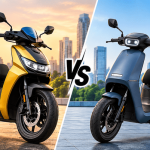

Ola Roadster vs Revolt RV400: Price, Range, Performance, Charging Time and Ownership Comparision 2026

Ola Roadester and Revolt RV400, these two are most prominent name in 2-wheeler commuter ev bike segment. Indus ev noticed, there are users who are still in doubt which bike they should buy from these two, Specially after compliance and services related issues in Ola ev scooters, people are thinking twice to buy Ola EVs. While Revolt RV400 is offering good durability and customer service but lesser range and speed. Which EV you should buy, take a look comparison of both evs and decide which suits your needs.
On paper, the Ola Roadster has an easy advantage over the Revolt RV400. Its larger battery options, higher claimed range and considerably stronger performance make the comparison look one-sided.
But an electric motorcycle is not bought on a specification sheet alone.
For someone living in an apartment, the RV400’s removable battery could be more useful than the Roadster’s larger fixed battery. For a rider who regularly uses open roads, the situation changes again, because the Roadster’s higher top speed and stronger motor give it a much wider performance envelope.
That makes the Ola Roadster vs Revolt RV400 comparison less about finding the motorcycle with the biggest numbers and more about understanding how each one fits into everyday Indian riding.
The Roadster is the newer, performance-and-technology-focused option. The RV400 is an older electric motorcycle platform that has been on sale since 2019 and puts greater emphasis on urban usability and battery removability.
Here is how the two stack up on price, range, charging, performance and the less glamorous part of EV ownership: what happens after the purchase.
Ola Roadster vs Revolt RV400: Key Specifications
The Roadster range was introduced with three battery capacities — 3.5 kWh, 4.5 kWh and 6 kWh. At launch, the announced prices were ₹1,04,999, ₹1,19,999 and ₹1,39,999 respectively.
The top-spec version claimed up to 248 km of IDC range, which put the Roadster among the more ambitious electric motorcycles in its price category.
The RV400 uses a smaller 3.24 kWh battery and has a claimed range of around 150 km. Revolt has also introduced the more affordable RV400 BRZ.
| Specification | Ola Roadster | Revolt RV400 |
|---|---|---|
| Battery options | 3.5 kWh, 4.5 kWh, 6 kWh | 3.24 kWh |
| Claimed range | Up to 248 km IDC | Up to 150 km IDC |
| Top speed | Up to 126 km/h | 85 km/h |
| Peak power | Up to 13 kW | Lower than Roadster |
| Battery | Fixed | Removable |
| Riding modes | Multiple, depending on variant | Eco, Normal, Sport |
| Primary character | Performance-oriented | Urban commuter |
| Introduction | Roadster family unveiled in 2024 | RV400 launched in 2019 |
Prices, equipment and variant availability can change with model-year updates, location and manufacturer offers. Buyers should check the applicable ex-showroom and on-road price before booking.
Roadster vs RV400: Six Years of Difference Matters
Revolt got a significant head start.
The RV400 was launched in India in 2019, at a time when electric motorcycles were still a relatively unusual sight on Indian roads. Ola unveiled the Roadster family in August 2024, with the production Roadster X range subsequently entering the market in 2025.
That gap matters because an EV is more than a motor, frame and battery.
There is a battery-management system, motor controller, electronics, software, charging equipment and a supply chain for replacement components behind the motorcycle. The longer a platform has been in the market, the more opportunity there is for manufacturers and workshops to build familiarity with those systems.
That does not automatically make an older platform better. The Roadster represents a newer approach, with Ola placing considerably more emphasis on performance, connectivity and technology.
So the two motorcycles arrive with very different histories.
Range Is Only Half the Charging Equation
The numbers initially make this look easy.
A Roadster with its largest battery can claim up to 248 km of IDC range, while the RV400 is rated for around 150 km.
For a rider covering long distances, that difference can be significant. For someone commuting 25–40 km a day, it may barely change the ownership experience.
IDC figures are laboratory-derived claims, not a guarantee of the distance you will achieve in everyday riding. Speed, traffic, riding mode, temperature, rider weight, road surface and tyre pressure can all affect energy consumption.
Then there is a factor that is rarely given enough attention: where the motorcycle gets charged.
The RV400’s removable battery can be taken off the motorcycle and charged separately. That creates a very different ownership proposition for someone who parks in a basement, rented property or apartment where there is no convenient socket near the motorcycle.
In that situation, carrying a battery indoors can be more practical than running an extension cable or searching for another charging arrangement.
The RV400’s standard charging time is around 3.5 hours for 0–80%, while a fast-charging option has also been offered.
The Roadster’s larger batteries naturally require more energy to replenish, with published charging times varying by battery and charging configuration.
So the better question isn’t simply, “Which one charges faster?”
It is “Which one is easier for me to charge?”
For a homeowner with a dedicated parking space and a reliable electrical connection, the Roadster’s larger battery is attractive. For an apartment resident without charging access at the parking spot, the RV400’s removable battery can solve a much more immediate problem.
Performance: These Two Motorcycles Target Different Riding Styles
The biggest mechanical difference becomes obvious once you leave a city street.
The top Roadster is rated at up to 13 kW of peak power, with a claimed 126 km/h top speed and around 2.2 seconds for 0–40 km/h.
It also gets a considerably more technology-heavy package, including a large TFT display, connected functions, navigation, multiple riding modes, reverse functionality, cruise control and OTA-related features.
The RV400 is considerably more conservative. Its 85 km/h top speed is well suited to urban commuting but gives the motorcycle a narrower operating window once speeds rise.
For someone spending most of the week riding through city traffic, the difference may not matter much. At 40–60 km/h, both motorcycles can serve the basic purpose of getting from one place to another.
The equation changes on faster roads.
If your regular route includes ring roads, bypasses or stretches where maintaining 70–80 km/h is common, the Roadster’s additional performance gives it considerably more headroom.
This is also where the Roadster’s higher power starts becoming more than a number on a specification sheet. It gives the rider more flexibility when accelerating or overtaking.
What Makes the Ola Roadster Attractive?
The Roadster is clearly designed to appeal to buyers who don’t want their electric motorcycle to feel like a compromise.
Its styling, performance and technology are all part and specifications of the proposition.
The motorcycle has the proportions and visual character expected from a conventional performance-oriented motorcycle, while the digital interface and connected features push it firmly into the modern EV category.
The performance figures reinforce that positioning.
A claimed top speed of 126 km/h places the Roadster in a very different category from an 85 km/h motorcycle. Buyers who occasionally travel outside the city are likely to notice that difference much more than someone whose daily route consists entirely of urban streets.
The larger battery options also give buyers more choice rather than forcing every customer into the same range-performance package.
Where the Revolt RV400 Makes a Stronger Case
The RV400 takes a less ambitious route.
Its appeal comes from the combination of familiar motorcycle proportions, urban-friendly performance and a removable battery.
The latter is arguably its most distinctive practical advantage.
A claimed 150 km of range may appear modest next to the Roadster’s 248 km, but range isn’t consumed in one large chunk. If a rider covers 30 km a day, the difference in battery capacity may be far less important than whether the motorcycle can be conveniently charged every night.
The RV400’s longer market presence also gives it an advantage in one specific area: familiarity.
It has been around since 2019, whereas the Roadster is a much newer platform. That doesn’t guarantee trouble-free ownership, but it does give buyers a longer product history to examine.
For someone looking for an electric motorcycle primarily for city transportation, that can be a meaningful consideration.
Battery Life and Long-Term Durability
Battery warranty is one of the first things an EV buyer should examine, but it shouldn’t be the only one.
A warranty protects the owner against the failures and conditions specified in the warranty document. It does not mean the battery will maintain its original capacity indefinitely.
Battery degradation can be influenced by factors including usage, charging patterns, temperature and operating conditions.
Before buying either motorcycle, it is worth asking:
- What happens when battery capacity falls substantially?
- What is the replacement cost outside warranty?
- How readily are replacement components available?
- How long could a major battery or electronics repair take?
- Is there an authorised workshop close to home?
- Are technicians trained to work on the particular model?
Revolt has offered battery warranty coverage of up to 8 years/80,000 km under applicable plans and conditions.
Ola’s applicable warranty depends on the motorcycle, purchase date and warranty package. Buyers should therefore read the actual warranty terms for the vehicle they are purchasing rather than comparing headline warranty numbers alone.
For long-term ownership, the warranty is only one part of the equation. The cost and availability of repairs after the warranty period can matter just as much.
Service Network: Check Your City Before You Book
This is one area where a showroom visit isn’t enough.
An EV motorcycle can look compelling on a specification sheet, but ownership becomes very different if the nearest authorised workshop is difficult to reach or routinely has to wait for parts.
Ola has been expanding its service infrastructure and has developed digital and service-support systems around its electric vehicles.
Revolt operates through its Revolt Hub network along with app-based and customer-support channels.
The catch is that the ownership experience can differ between cities.
A buyer in a major metro may have several options. Someone in a smaller city may have a very different experience.
Online reviews can help identify recurring themes, but individual complaints should not be treated as proof of a universal problem. If multiple owners in the same area repeatedly mention parts delays, repair waiting periods or communication issues, however, that is worth investigating.
The simplest check is often the most useful: visit the service centre before buying the motorcycle.
Ask how many units of the model they regularly service, which parts are stocked locally, how battery-related cases are handled and what happens if the motorcycle cannot be ridden to the workshop.
Those answers tell you something that a range figure cannot.
Warranty Claims and Service Documentation Matter
Electric motorcycles introduce another layer of complexity because some faults can involve software, electronics, the motor controller or battery-management system rather than conventional mechanical components.
That makes documentation particularly useful when something goes wrong.
Keep the:
- Purchase invoice
- Warranty documentation
- Service invoices
- Job cards
- Battery-related reports
- Complaint or reference numbers
If a significant warranty issue develops, make sure the complaint is formally recorded.
A job card describing the problem is considerably more useful than a verbal promise that a replacement component is “on the way”.
This becomes particularly relevant when a fault involves several electronic components and the final diagnosis takes time.
The Electric Motorcycle Market Is Getting More Competitive
The Roadster and RV400 are entering a market that has changed considerably since the RV400 arrived.
TVS, Bajaj, Ather, Hero and other manufacturers have expanded their electric two-wheeler portfolios. Buyers now have more options across both scooters and motorcycles.
That has also changed the buying criteria.
Price remains important, but buyers are increasingly comparing the entire ownership proposition: battery warranty, charging convenience, service reach, software support, financing, resale prospects and running costs.
Scale is another factor, although it needs to be interpreted carefully.
August 2026 Vahan-based figures cited in industry reporting showed around 13,849 Ola electric two-wheeler registrations and approximately 912 Revolt registrations. Those are manufacturer-level figures, not Roadster and RV400 sales figures.
They therefore cannot be used as a direct model-versus-model sales comparison.
Neither company provides a simple, continuously updated public lifetime sales figure that can reliably be used to compare total Roadster and RV400 sales.
That distinction is important when reading EV sales stories. A manufacturer’s registrations are not automatically the sales number for one particular motorcycle.
What the Next Generation of Electric Motorcycles Could Improve
Battery capacity has been one of the easiest numbers for manufacturers to highlight.
But the next stage of electric-motorcycle development is likely to be about how efficiently that battery can be used.
Faster charging, better thermal management, improved battery chemistry, more efficient motors and smarter controllers could all make a difference.
There is also a bigger infrastructure question.
For years, the industry has focused on increasing battery size to reduce range anxiety. But for many Indian buyers, access to charging may be a bigger obstacle than battery capacity itself.
A large fixed battery works extremely well when the motorcycle can be parked beside a reliable power source. A removable battery has a different advantage: it brings the charging point to the battery.
That distinction could remain important as electric motorcycles move beyond early adopters and into a much wider range of Indian households.
Ola Roadster: Pros and Cons
Pros
- Higher top speed
- Considerably more peak power
- Up to 248 km claimed IDC range
- Multiple battery options
- Strong technology and connected features
- Better suited to riders who regularly use faster roads
Cons
- Larger battery variants require more charging time
- Fixed battery limits charging flexibility in some parking situations
- Newer platform than the RV400
- Local service experience should be checked before purchase
Revolt RV400: Pros and Cons
Pros
- On sale since 2019
- Removable battery
- Urban-friendly performance
- Up to 150 km claimed IDC range
- Conventional motorcycle design
- Longer product history
- Extended battery warranty options
Cons
- 85 km/h top speed
- Smaller battery
- Less suited to frequent high-speed highway use
- Service experience may differ by location
- Local parts availability should be verified
Which One Makes More Sense for Different Riders?
There isn’t one answer that works for every Roadster or RV400 buyer because the two motorcycles solve slightly different problems.
For the performance-focused rider
The Ola Roadster is the more natural fit if acceleration, top speed and higher-speed riding are significant parts of your routine.
Its additional performance also gives more flexibility when riding on open roads.
For the urban commuter
The Revolt RV400 can make more sense when the motorcycle is primarily being used for city travel and the 85 km/h top speed is sufficient.
Its removable battery becomes particularly useful when the parking space does not have a charging point.
For an apartment resident
This is one situation where the RV400 deserves a closer look.
A large fixed battery sounds attractive until you realise that the motorcycle is parked several floors away from the nearest socket. A removable battery changes that equation completely.
For a rider with home charging
The Roadster’s larger battery becomes more appealing when charging is straightforward.
If the motorcycle can be plugged in at home every night, the convenience of carrying a larger battery without worrying about daily charging frequency can outweigh the benefits of a removable unit.
For frequent highway riders
The Roadster’s higher top speed and substantially greater power make it the more suitable proposition for riders who regularly travel on faster roads.
That doesn’t turn it into a touring motorcycle by default, but it gives the rider significantly more performance headroom than the RV400.
Ola Roadster vs RV400: Look Beyond the Bigger Number
The Ola Roadster and Revolt RV400 represent two different interpretations of what an electric motorcycle should be.
The Roadster puts more emphasis on performance, battery capacity, range and technology. Its strongest numbers are difficult to ignore, particularly for riders who spend time outside dense city traffic.
The RV400 takes a more established and practical approach. Its removable battery, urban-friendly performance and longer product history address everyday ownership concerns that aren’t always visible in a specification table.
So before choosing between them, start with the motorcycle’s actual job.
Where will it be parked?
Can you charge it there?
How many kilometres do you ride on a normal day?
Do you regularly use highways?
How far away is the authorised workshop?
And what is your plan if a major electronic or battery component needs attention after the warranty period?
Those questions can change the value equation more dramatically than another few kilowatt-hours on a brochure.
For the Roadster, the appeal lies in having an electric motorcycle that pushes harder on performance and technology. For the RV400, the attraction is a simpler urban proposition with battery-removal flexibility and a longer history in the Indian market.
The better fit depends less on which specification looks bigger and more on whether the motorcycle’s battery, charging arrangement, performance and service network work with the way you actually live and ride. Stay tuned with Indus ev for more ev industry news.