
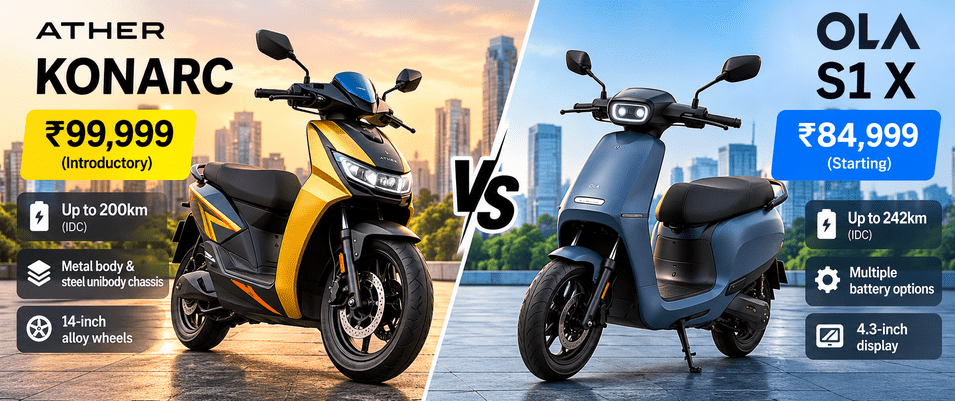

The ₹1 lakh electric scooter segment is becoming increasingly competitive, with manufacturers trying to balance price, range, hardware and connected features. Ather’s Konarc and Ola’s S1 X approach the mainstream market differently, even though they are aimed at overlapping buyers.
The more interesting comparison, therefore, is not simply which scooter has the higher claimed range or lower starting price. It is how each manufacturer has chosen to build an electric scooter around this price point.
Ather Konarc vs Ola S1 X: Price
Ather has positioned the Konarc around the ₹1 lakh price point, while the Ola S1 X range has a lower starting price depending on the battery variant and applicable pricing.
This gives Ola an advantage for buyers whose primary consideration is the initial purchase price. Ather, meanwhile, is positioning the Konarc around its hardware and overall product proposition.
| Model | Starting price* | Battery options | Claimed range |
|---|---|---|---|
| Ather Konarc | ₹99,999 introductory* | Multiple configurations | Up to 200 km IDC* |
| Ola S1 X | ₹84,999* | 2 kWh, 3 kWh, 4 kWh | Up to 242 km IDC* |
*Prices, variants and specifications should be checked against the latest manufacturer information before publication because EV pricing and availability can change.
Battery and Range: Different Strategies
Battery choice is one of the biggest differences between the two scooters.
The Ola S1 X is available with multiple battery configurations. Its 2 kWh, 3 kWh and 4 kWh versions offer different claimed IDC ranges, allowing buyers to choose a scooter according to their daily riding requirements and budget.
Ather’s Konarc is also offered in different range configurations, with versions covering lower and higher claimed range requirements.
That makes the comparison highly dependent on the exact variants being considered.
For buyers travelling only around 30–50 km a day, paying extra for the largest battery may not necessarily make financial sense. On the other hand, riders who regularly cover longer distances may value the additional energy capacity.
It is also important to remember that IDC range is a certified test figure, not a guarantee of real-world range. Actual range can vary with riding speed, traffic, rider weight, temperature, road conditions, tyre pressure and use of air conditioning or other electrical loads.
Hardware and Build
Ather has taken a hardware-focused approach with the Konarc.
The scooter features a metal body, steel unibody chassis, 14-inch alloy wheels and long-travel suspension. These characteristics are particularly relevant for buyers who prioritise the physical construction and ride-oriented hardware of a scooter.
The Ola S1 X follows a different product philosophy, with its Gen 3 platform, mid-drive motor and connected software ecosystem.
For an urban buyer, both approaches can make sense. The deciding factor is likely to be whether the buyer places greater importance on hardware and physical robustness or on software, connected features and battery-choice flexibility.
Software and Features
Ola has built the S1 X around its MoveOS software ecosystem, with connected features forming an important part of the ownership experience.
The S1 X also gets a 4.3-inch display, while equipment and features can vary according to the particular variant.
Ather has also developed a strong software ecosystem around its electric scooters, making software and connected functionality an important part of the Konarc proposition.
The difference is therefore less about whether either scooter has software and more about the overall product philosophy each manufacturer is pursuing.
Which Scooter Makes More Sense?
There is no single answer because the two scooters target slightly different priorities.
The Ather Konarc may appeal to buyers who:
- Prefer a more hardware-focused scooter.
- Value a metal body and steel chassis.
- Want 14-inch wheels.
- Prefer Ather’s software and ownership ecosystem.
- Are comfortable with a starting price around the ₹1 lakh mark.
The Ola S1 X may appeal to buyers who:
- Want a lower entry price.
- Prefer multiple battery options.
- Want to choose between different range configurations.
- Value MoveOS and connected features.
- Want a scooter aimed strongly at everyday urban use.
The Bigger Question for ₹1 Lakh EV Buyers
The Ather Konarc vs Ola S1 X comparison highlights an important change in India’s electric scooter market.
Buyers are no longer choosing between just a handful of electric scooters. They increasingly have options differentiated by battery size, range, software, hardware, performance and ownership ecosystem.
That means the headline price alone does not tell the complete story.
A buyer covering short urban distances every day may find a smaller-battery variant sufficient. Someone regularly travelling longer distances may be willing to spend more for additional battery capacity.
Similarly, a buyer should look beyond specifications and check service availability, warranty coverage, charging access, replacement costs and local ownership experience before making a purchase.
Final Takeaway
The Ather Konarc and Ola S1 X represent two different approaches to the mainstream electric scooter market.
The Ola S1 X focuses strongly on entry price, battery choice and connected technology, while the Ather Konarc puts greater emphasis on its hardware package and overall scooter construction.
For buyers, the right comparison is therefore not simply Konarc vs S1 X. It is which variant fits your daily distance, budget, charging situation and ownership priorities.