
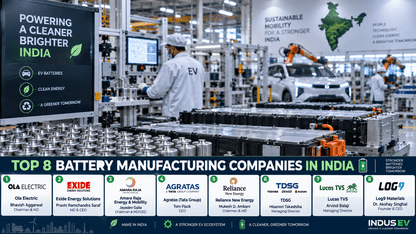

Ask almost anyone what India’s EV boom looks like and they’ll describe the vehicles, scooters darting through city traffic, electric SUVs rolling out of showrooms, three-wheelers quietly retiring their diesel cousins. What hardly anyone pictures is the part that actually decides whether the whole thing holds together: the cell inside the battery.
That’s where the real contest has moved.
For years, India was good at the visible half of the job. Companies assembled battery packs on home soil while importing the cells that gave those packs most of their value. It worked, but it left the country’s single most strategic EV component sitting inside someone else’s supply chain. That arrangement is finally starting to change, and the list of companies trying to change it reads like a who’s who of Indian industry.
Ola Electric, Exide Energy Solutions, Amara Raja Energy & Mobility, Tata Group’s Agratas and Reliance are all pouring capital into large-scale battery manufacturing and energy storage. Around them sit specialists like TDSG, Lucas TVS and Log9 Materials, each building a different piece of the puzzle, automotive batteries, battery packs, advanced cells, fast-charging technology.
But here’s the detail that tends to get buried under the gigafactory press releases: India is building battery capacity far faster than it is actually manufacturing cells at scale.
The government’s own numbers make that gap hard to ignore. Under the Production Linked Incentive (PLI) scheme for Advanced Chemistry Cells (ACC), 40 GWh of manufacturing capacity had been awarded against a 50 GWh target, yet only 1 GWh had actually been installed under the programme as of December 31, 2025. New Delhi has also been candid about why the rest is taking time, pointing to gaps in technology, skilled manpower, imported equipment and the thin domestic supply of upstream materials.
Which is exactly what makes this race worth watching. The announcements are done. The next few years will decide whether they turn into factories that produce cells consistently, competitively, and at real scale.
India’s EV battery manufacturing race: the key numbers
| Company / Programme | Battery focus | Announced / planned capacity | Current status / milestone | Key location |
|---|---|---|---|---|
| Ola Electric | 4680 ACC cells | 20 GWh PLI allocation | Pilot production and commercial scale-up | Krishnagiri, Tamil Nadu |
| Exide Energy Solutions | Li-ion cells + battery packs | 6 GWh initially, scalable to 12 GWh | Cell manufacturing facility being developed | Bengaluru, Karnataka |
| Amara Raja Energy & Mobility | Cells + battery packs | Up to 16 GWh | Giga Corridor under development | Telangana |
| Agratas (Tata Group) | Advanced battery cells | 20 GWh in Phase 1 | Sanand facility under development | Gujarat |
| Reliance New Energy | Batteries + energy storage | 40 GWh initial phase; 100 GWh roadmap | Gigafactory development progressing | Jamnagar, Gujarat |
| TDSG | Automotive Li-ion batteries | – | Automotive battery manufacturing already established | Gujarat |
| Lucas TVS | Li-ion battery packs / cells | – | Battery-pack manufacturing and cell technology development | Tamil Nadu |
| Log9 Materials | Advanced / fast-charging cells | – | Indigenous cell manufacturing being scaled | Bengaluru |
| Government PLI-ACC programme | Advanced Chemistry Cells | 50 GWh target | 40 GWh awarded; 1 GWh installed | Pan-India |
A quick word on this table: the capacity figures aren’t directly comparable. Some are announced or planned manufacturing capacity; others are government-awarded capacity. A dash means a comparable current figure isn’t available, not that it’s been estimated.
India’s battery manufacturing snapshot
50 GWh, Government PLI-ACC manufacturing target 40 GWh, Capacity awarded under the programme 1 GWh, Capacity installed under the PLI programme as of December 31, 2025 ₹18,100 crore, PLI-ACC scheme outlay
Read the table closely and one thing jumps out: India’s battery story is still mostly about capacity being built, not capacity already running. And that gap matters far more than it looks.
A gigawatt-hour in a press release is not the same as cells coming off a line at commercial scale. For India’s EV industry, the milestone that counts isn’t the announcement, it’s sustained production, competitive costs, consistent quality and a steadily rising share of domestic value.
Why the cell: Not the pack, is the real prize
A battery pack is a lot more than a box of cells.
The cells are the fundamental energy-storage units. They’re assembled into modules and packs, then wired together with the battery-management system, thermal-management hardware, power electronics and safety systems that turn raw storage into something a vehicle can actually use.
For a carmaker, owning more of that chain means owning more of its own destiny, over cost, over product development, over supply security. That’s the whole reason India’s battery ambition has outgrown its old model of importing cells and assembling packs at home.
The PLI-ACC programme was designed to seed 50 GWh of domestic Advanced Chemistry Cell capacity, cut import dependence, and pull investment into a home-grown battery ecosystem. But making the cell is only half the problem. India also needs the materials, the machinery, the engineering depth and the supporting supply chain to make batteries competitively, and that part is harder than any single factory announcement suggests.
1. Ola Electric
Ola Electric is the most visible attempt in the country to pull vehicle-making and battery-making under one roof. Under founder, chairman and managing director Bhavish Aggarwal, the company has built its cell operation around the 4680 format at its Gigafactory in Krishnagiri, Tamil Nadu, and says it began manufacturing 4680-format cells there in March 2024. It has since put those cells, branded the 4680 Bharat Cell, into its own vehicles, and has talked up work on indigenous LFP cell technology. Its PLI allocation stands at 20 GWh.
The bet here is vertical integration: cells, pack integration and vehicles inside one ecosystem, with as little outsourced as possible. The number to watch isn’t the 20 GWh allocation. It’s how quickly Ola can scale actual cell output, and how much of the underlying technology and supply chain it can genuinely localise rather than quietly import.
2. Exide Energy Solutions
Few names carry as much battery history in India as Exide, and it’s leaning hard on that legacy as it makes the jump to lithium-ion. Through its wholly owned subsidiary, Exide Energy Solutions Limited (EESL), the company is building a greenfield lithium-ion cell plant in Bengaluru with a planned initial capacity of 6 GWh, scalable to 12 GWh. The facility is designed to handle both cylindrical and prismatic formats across multiple chemistries, including LFP and NMC.
There’s also been a change at the top. Pravin Ramchandra Saraf is now MD & CEO of Exide Energy Solutions, taking over after Mandar Deo resigned in December 2025.
3. Amara Raja Energy & Mobility
Amara Raja is playing a wider field than most of its rivals. Chaired and managed by Jayadev Galla, the company is building its Giga Corridor in Divitipally, Telangana, around both lithium-ion cell and battery-pack manufacturing, with a long-term target of up to 16 GWh. It has also stood up ePositive Energy Labs to work on battery materials, cell chemistry, pack design and battery-management systems.
What’s easy to miss is that Amara Raja’s lithium ambitions were never only about cars. It has already been deploying lithium-based energy-storage systems in India’s telecom sector, a useful reminder that battery demand in this country is going to come from a great deal more than passenger EVs. By straddling automotive and stationary storage, Amara Raja is effectively hedging across several demand curves at once.
4. Agratas (Tata Group)
Tata Group is pursuing batteries through Agratas, its dedicated global battery business, led by CEO Tom Flack. Agratas is developing large-scale manufacturing in both India and the UK, and its Sanand project in Gujarat, with a planned first phase of around 20 GWh, is meant to feed both electric mobility and energy storage. The company isn’t limiting itself to churning out cells, either; it’s working across cell technology, manufacturing systems and battery integration.
For Tata Motors, this is more than a supply arrangement. As the group’s EV line-up widens, control over battery supply shifts from a line item to a strategic lever. That’s the real significance, one of India’s biggest carmakers is tied to a purpose-built global battery business, rather than treating the battery as something to buy off a shelf.
5. Reliance New Energy
Reliance is thinking about batteries as one wing of a far bigger new-energy play. At the Dhirubhai Ambani Green Energy Giga Complex in Jamnagar, chairman and managing director Mukesh D. Ambani is building out energy storage, solar manufacturing, hydrogen and power electronics side by side. The battery roadmap starts at a 40 GWh phase and points toward 100 GWh of annual capacity, and the company has secured a 10 GWh ACC allocation under the PLI scheme.
What makes Reliance’s position unusual is that its battery business doesn’t live or die on passenger-EV demand. As renewable generation climbs, grid and stationary storage could become just as large a market as electric cars. That breadth, batteries wired into an entire renewable-energy ecosystem rather than a single end use, is the whole point of the strategy.
6. TDSG
TDSG stands apart from most of this list for a simple reason: it’s already running. TDS Lithium-Ion Battery Gujarat Private Limited, a joint venture between Toshiba, Denso and Suzuki, led by managing director Hisanori Takashiba, manufactures lithium-ion batteries for automotive use today, not somewhere on a future roadmap.
It’s also a useful corrective to the assumption that India’s battery story is purely an EV story. TDSG’s batteries matter for hybrids too, including within the Suzuki ecosystem. In a landscape crowded with proposals and renderings, an operating automotive battery plant is worth a great deal more than a plan for one.
7. Lucas TVS
Lucas TVS, under managing director Arvind Balaji, is another established components player from Tamil Nadu moving into lithium-ion. Its EV business has built battery-pack manufacturing capability, while the wider group works on next-generation cell technology.
That distinction matters more than it might sound. Assembling a sophisticated battery pack and manufacturing the cell inside it are two very different disciplines, the latter demands a far more complex technology and production ecosystem. So Lucas TVS is worth tracking on two separate timelines: the packs it can build right now, and how far its cell-development work actually travels. Either way, packs, BMS, power electronics, thermal management and integration will stay essential to India’s EV supply chain long after domestic cell output ramps up.
8. Log9 Materials
Then there’s the startup end of the race. Bengaluru-based Log9 Materials, founded and led by Dr. Akshay Singhal, has built its reputation on advanced battery technology and fast-charging applications, and has been developing indigenous cell manufacturing along the way. In September 2026, it unveiled an indigenous cell manufacturing facility at its Bengaluru campus, a step the company frames as central to commercialising battery technology developed on home soil.
Log9 matters less for its scale than for what it represents. India’s battery industry isn’t being built only by conglomerates and carmakers. Startups are chasing proprietary cell chemistries and manufacturing know-how too, and some of the most interesting technology could end up coming from exactly this corner of the market.
The harder problem isn’t making cells
It’s tempting to scan the list of proposed gigafactories and conclude that localisation is basically solved. The data says otherwise.
The government has been unusually frank about what’s holding domestic ACC manufacturing back: technology availability, skilled manpower, dependence on imported equipment, and, the one that gets least attention, the limited domestic supply of key upstream materials.
That last point deserves far more weight than it usually gets. A cell factory does not, on its own, create a local supply chain. Cells need cathode and anode materials, electrolytes, separators and more. If those keep arriving from abroad, India can raise its cell output substantially and still be nowhere near supply-chain independence. Making the cell is one piece of localisation, not the whole of it.
From raw materials to recycling, the opportunity is far bigger than the factory
Zoom out, and India’s battery ecosystem stretches across a long chain:
Raw materials → active materials → cell manufacturing → modules → battery packs → BMS → thermal management → charging → recycling
Each link is its own industry. Battery-management systems decide how individual cells are monitored and controlled. Thermal management shapes temperature, performance and how long a pack survives. And recycling, easy to wave away today, becomes unavoidable as the first big wave of EV batteries reaches the end of its first life. The government has already begun moving here, introducing measures to strengthen critical-mineral recycling from spent lithium-ion batteries and electronic waste.
Put simply, the battery opportunity could eventually run well past the factories making headlines right now.
What this actually means if you’re buying an EV
If you’re shopping for an electric car or scooter, all of this can sound like a problem for industry, not for you. It isn’t.
The battery sits at the centre of an EV’s cost, range, charging capability and long-term ownership maths. Over time, a stronger domestic ecosystem could feed into:
- more resilient battery supply chains
- deeper localisation of EV components
- potentially lower manufacturing costs at scale
- faster rollout of new battery technologies
- a stronger local repair and service network
- more competition among battery suppliers
- growth in stationary energy storage
But keep one caveat firmly in mind: more domestic manufacturing does not automatically mean cheaper EVs or longer range. Cell chemistry, energy density, raw-material prices, manufacturing scale, vehicle efficiency, thermal management and charging technology all keep pulling on the final product, no matter where the cell was made.
For buyers, then, the milestone that counts isn’t the gigawatt-hour figure in a headline. It’s whether those gigawatt-hours turn into reliable, competitive and increasingly local battery production.
India is building capacity. The real test is scale.
Ambition, clearly, is not the problem. Ola is chasing indigenous cells; Exide and Amara Raja are standing up lithium-ion manufacturing; Tata’s Agratas is building at scale across two countries; Reliance is folding batteries into an integrated energy strategy; and TDSG, Lucas TVS and Log9 are filling in different corners of the ecosystem. The government, for its part, has put real incentive money behind domestic ACC capacity.
But there’s a meaningful difference between announced capacity, awarded capacity, installed capacity and commercially scaled production, and over the next few years, that difference may be the single most useful metric to track.
India doesn’t need more battery factories on paper. It needs factories that can turn out cells consistently, at competitive cost, with a rising share of domestic value. And it needs the ecosystem around them, materials, machinery, engineering talent, electronics, thermal management, recycling, to grow at the same pace.
The EV story began with the vehicle. The next chapter looks like it’ll be written by the battery. The question is no longer really whether India can build EVs.
It’s whether it can build enough of the battery value chain sitting behind them. Keep in touch with Indus ev for more update on ev development in India.
Editorial fact check
Verified:
- Government PLI-ACC programme target: 50 GWh– Link
- PLI-ACC capacity awarded: 40 GWh
- PLI-ACC capacity installed as of December 31, 2025: 1 GWh
- PLI-ACC scheme outlay: ₹18,100 crore
- Ola Electric has developed 4680-format cell manufacturing capabilities: Link
- Exide Energy Solutions has announced an initial 6 GWh, scalable to 12 GWh, lithium-ion cell manufacturing facility : Link
- Amara Raja has stated a long-term up to 16 GWh cell and battery-pack manufacturing target : Link
- Agratas’ first-phase Gujarat battery facility is planned at approximately 20 GWh : Link
- Reliance has announced an initial 40 GWh battery manufacturing phase and a roadmap towards 100 GWh annual capacity : Link
Also Read:
Top 5 EV Leaders In India Shaping India EV Future
Top 10 Best Selling Cars India 2026 January-June1


