
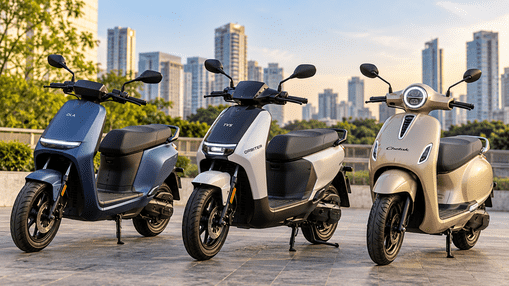
Ola S1Z vs TVS Orbiter vs Bajaj Chetak C25: Three EV Scooters Around ₹1 Lakh, But Their Priorities Are Very Different

Ola’s S1Z claims up to 301 km of IDC range from its 5.1 kWh battery, and its introductory ₹99,999 price sits almost exactly where TVS launched the Orbiter. On paper, that looks like the obvious pick. The catch is timing: Ola lists deliveries of the 3.1 kWh S1Z from December 2026 and of the 5.1 kWh version from March 2027. The TVS Orbiter and Bajaj Chetak C25 are already on sale.
So a buyer shopping around the ₹1 lakh mark this festive season is not only comparing three spec sheets. They are also deciding whether a range claim several months away is worth more than a scooter available now, from a brand with an established service network.
All three are priced in roughly the same band. Each is built around a different idea of what a buyer at this price should get.
| Comparison Metrices | Ola S1Z 3.1 kWh | Ola S1Z 5.1 kWh | TVS Orbiter 3.1 kWh | Bajaj Chetak C25 |
|---|---|---|---|---|
| Launch/introductory price* | ₹79,999 | ₹99,999 | ₹99,900 | ₹91,399 |
| Battery | 3.1 kWh | 5.1 kWh | 3.1 kWh | 2.5 kWh |
| Claimed IDC range | 179 km | 301 km | 158 km | Up to 113 km |
| Claimed top speed | 70 kmph | 70 kmph | Not stated in TVS’s listed specifications | 55 kmph |
| Claimed home charging (0–80%) | 5 hr 42 min | 6 hr 16 min | 4 hr 10 min (650W charger) | 2.25 hr (750W charger) |
| Boot space | Not listed | Not listed | 34 litres | 25 litres |
| Availability | Deliveries from Dec 2026 | Deliveries from Mar 2027 | On sale | On sale |
*Introductory or launch prices. The Orbiter’s ₹99,900 launch price in Bengaluru included the PM E-Drive benefit. On-road prices vary by city, subsidy, insurance, registration charges, variant and current offers. All range, speed and charging figures are manufacturer claims.
Same battery size, a 21 km gap
The most revealing pairing is not Ola against Bajaj. It is the two 3.1 kWh scooters.
The OLA S1Z and the Orbiter carry the same nominal battery capacity. Ola nevertheless claims 179 km of IDC range against TVS’s 158 km. IDC is a standardised test cycle, so that 21 km gap points either to better efficiency on the test or to a difference in how much of each pack can actually be used. Neither spec sheet says which.
In a showroom, it is fair to ask what the usable capacity is on each scooter. The answer matters more than the headline kWh figure.
Neither IDC number is a promise for the road. Traffic, riding speed, rider and pillion weight, gradients, heat and riding mode all eat into range. Use the certified figures to compare these three scooters against each other, not to plan a week of commuting.
How long each takes to refill matters more than it looks
This is where the C25’s modest battery works in its favour. Bajaj claims 0–80% in about two and a quarter hours with its 750W off-board charger. TVS quotes 4 hours 10 minutes for the Orbiter with its standard 650W charger. Ola lists 5 hours 42 minutes for the 3.1 kWh S1Z, and 6 hours 16 minutes for the 5.1 kWh version.
For someone charging overnight in a house with a socket near the parking spot, none of these times is a problem. The scooter is full by morning either way.
The picture changes for an apartment resident who can only charge at a shared point, or who plugs in for a couple of hours after work. Two hours on the C25 recovers most of its battery. The same two hours on an S1Z adds a much smaller share of a bigger pack.
A larger battery means fewer charging sessions, but each session is longer. Which matters more depends on where the socket is.
Where the 55 kmph top speed shows up
Bajaj rates the C25 at 55 kmph, against 70 kmph for the S1Z. Inside a crowded city centre, that difference barely registers.
On a ring road or a wide arterial road, where traffic moves at 50–60 kmph, a scooter that tops out at 55 kmph has little in reserve for overtaking. Bajaj describes the C25 as a compact urban scooter built for manoeuvrability in dense traffic. The top speed fits that description, and it sets a real limit for anyone whose daily route includes faster roads.
What TVS is selling instead of range
The TVS Orbiter’s selling point is everyday usefulness rather than battery size. It has a 34-litre boot, large enough for things a smaller boot cannot hold. It also gets a 14-inch front wheel, which generally helps over broken roads, along with cruise control and hill-hold assist. TVS adds connected features such as geo-fencing, time-fencing and fall or crash alerts.
According to TVS, the 3.1 kWh version weighs 112 kg and uses a 2.5 kW peak motor. A 1.8 kWh version with a shorter claimed range is also listed for buyers who want a lower price.
The C25 answers the practicality question differently. It has a 25-litre boot, hill-hold assist, disc brakes and a metal body, the construction Chetak buyers have long associated with the name. It is a smaller package that asks less of its owner. It also carries a badge that Bajaj says accounted for 3,02,674 domestic sales in FY2026, according to its annual report.
Service reach is a real difference
For a scooter you plan to keep for five or more years, the nearest service point can matter more than the kWh figure.
TVS and Bajaj sell and service their electric scooters through dealer networks built over decades of petrol two-wheeler sales. Ola is at a different stage. Until August 2026 it sold only through company-owned outlets. It has since opened its network to dealer partners and is targeting more than 500 dealerships over the next couple of quarters. By the time the first S1Zs are delivered, that network should be larger than it is today. How much larger in a particular town is worth checking locally before booking.
Before booking, check
- Your actual daily distance, and what a buffer of two or three days would require
- Whether you can charge where you park, and for how long
- The city-specific on-road price after subsidy, insurance and registration
- The distance to the nearest authorised service point
- Battery warranty terms for the specific variant
- For the S1Z, the confirmed delivery date for your battery option
A commuter covering 25 km a day would find all three scooters’ claimed ranges more than enough on paper. Even two days without charging comes to 50 km, well within the C25’s 113 km claim. For that buyer, the S1Z’s larger battery is capacity they may seldom use. The more relevant questions are how long the scooter takes to charge, how much it can carry and how close the service centre is.
The S1Z’s numbers matter most to riders who regularly cover long daily distances, or who cannot charge every night and need the scooter to last several days between top-ups. Those buyers now have to weigh a large range claim against a wait of up to six months for the 5.1 kWh version.
Stay updated with Indus ev for latest news and insight from electric vehicle industry.