
India’s electric two-wheeler market is growing at a rapid pace, but the bigger story is who is capturing that growth.
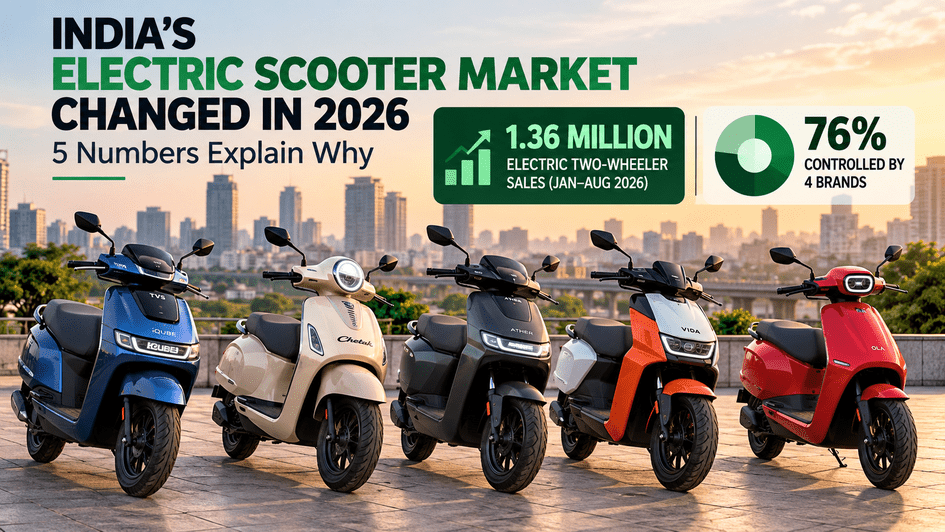
Around 1.36 million electric two-wheelers were retailed in India between January and August 2026. Yet four manufacturers, TVS Motor, Bajaj Auto, Ather Energy and Hero MotoCorp’s Vida, accounted for roughly 76% of that volume.
That is a significant change from a year earlier, when the same four companies held around 66% of the market.
The numbers suggest India’s EV two-wheeler market is moving beyond its early startup-led phase and becoming increasingly competitive around scale, distribution, product variety and brand reach.
Here are five numbers that explain the shift.
1. 13.6 lakh: India’s electric two-wheeler market is approaching a new scale
India recorded approximately 13.6 lakh electric two-wheeler retail sales during the first eight months of 2026.
August alone contributed 1,82,936 units, according to Vahan-based retail data reported by Autocar Professional. That was 67% higher than August 2025, although it was 11% below July’s record 2,05,629 units.
The eight-month number is important because the market has already moved close to the scale that would have seemed ambitious only a few years ago.
At the current pace, the industry is on course to approach or cross the 2-million-unit annual mark in 2026, although a full-year outcome will depend on monthly registrations during the remaining months.
The bigger point is not simply that EV sales are increasing.
The market underneath that growth is changing.
2. 10.39 lakh: Four manufacturers now control most of the market
TVS Motor, Bajaj Auto, Ather Energy and Vida collectively recorded 10,38,973 electric two-wheeler sales between January and August 2026.
That represents approximately 76% of India’s 1.36-million-unit market.
Even more strikingly, these four companies had already exceeded their entire combined 2025 volume of 9,22,824 units by the end of August.
Their January–August 2026 total was also 84% higher than the 5,65,635 units they recorded during the same period of 2025.
This is the clearest evidence of consolidation in India’s electric two-wheeler market.
There are still many manufacturers competing in the segment, but the majority of the industry’s volume is increasingly concentrated among a handful of brands.
3. 3,56,579: TVS has become the volume leader
TVS Motor recorded 3,56,579 electric two-wheeler sales between January and August 2026, giving it approximately 26% of the overall market.
Its volume was already higher than the company’s entire 2025 electric two-wheeler tally of 3,15,082 units. The January–August figure represented a 77% YoY increase.
The company’s electric portfolio is led by the iQube family, while the Orbiter gives TVS another product at the more affordable end of the market.
TVS itself reported 59,453 electric two-wheeler sales in August on a company-reported basis, up 137% from August 2025.
The difference between that figure and Vahan’s August retail number is worth remembering: manufacturer sales and retail registrations are not necessarily the same measurement.
For market-share comparisons in this article, the Vahan-based retail figures are used.
4. 3,05,226: Bajaj has turned Chetak into a serious volume player
Bajaj Auto recorded 3,05,226 electric two-wheeler sales during January-August 2026, putting it second behind TVS.
The company crossed the three-lakh mark after recording 41,019 Chetak sales in August.
Its August number was 235% higher than the year-ago figure, although that comparison is affected by supply-chain disruptions that had hurt Bajaj’s August 2025 performance.
More importantly, Bajaj’s eight-month 2026 sales have already exceeded its full-year 2025 total of 2,79,687 units.
That makes the Chetak story particularly interesting.
Bajaj did not enter the electric scooter market as an EV-only startup. It brought an established two-wheeler brand, manufacturing infrastructure and dealer ecosystem into the segment.
The 2026 numbers suggest that approach is translating into considerable volume.
5. 65,999: Ola’s H1 decline shows how quickly the market can change
Ola Electric’s story provides the other side of the market transformation.
The company registered 65,999 electric two-wheelers during January-June 2026, compared with 1,18,032 in the same period of 2025.
That represents a 44.1% decline. Ola’s market share also fell from 18.6% to 6.8% over the same comparison period.
The full January–August picture remained challenging.
Ola recorded 94,307 electric two-wheeler registrations, down 39% from 1,55,951 during the corresponding period of 2025. It ranked fifth in the Vahan-based eight-month data.
There has been some sequential improvement during the year, but it has not been enough to restore Ola’s earlier market position.
That distinction matters.
A company can sell more units than it did in a weak month and still lose market share if the overall market is growing faster.
That is effectively what the 2026 data illustrates.
The bigger shift: EV buyers are getting more choice
The market numbers point toward a broader change in Indian electric two-wheelers.
TVS and Bajaj are no longer simply traditional manufacturers experimenting with EVs. Their electric products have become major contributors to their two-wheeler businesses.
Ather, meanwhile, has continued to expand its volume while retaining its position as an EV-focused manufacturer. Its January–August sales reached 2,29,099 units, up 83% year on year.
Vida is another important part of the story.
The Hero-backed brand registered 1,48,069 units during the first eight months, up 151% year on year.
The result is a market in which buyers have more products and brands to consider — and where established distribution and service infrastructure are becoming increasingly important.
Is India’s electric scooter market becoming a scale game?
The 2026 numbers suggest that scale is becoming increasingly important, but they do not prove that one particular business model will ultimately dominate.
For consumers, several factors now sit alongside battery capacity and claimed range:
- Product availability
- Dealer and service reach
- Financing options
- Price positioning
- Battery options
- Charging ecosystem
- Brand familiarity
- After-sales support
- Product variety
This is particularly relevant as electric scooters move toward more mainstream price points.
The market is therefore becoming less about simply convincing consumers to try an EV and more about competing for customers who already consider an electric scooter a realistic alternative.
What this means for Ola, TVS, Bajaj and Ather
For TVS, the challenge is likely to maintain momentum while defending its rapidly established market leadership.
For Bajaj, the Chetak’s expansion shows the potential of combining a recognised legacy brand with a growing electric portfolio.
For Ather, the challenge is different: continue scaling without losing the technology and product differentiation that helped establish the brand.
For Vida, the 151% growth rate shows how quickly a smaller base can become meaningful when product availability and distribution improve.
And for Ola, the numbers demonstrate how quickly market leadership can become market-share pressure when competitors expand faster.
The important point is that none of these conclusions require assuming what will happen next.
The sales data already shows that the competitive structure of India’s electric two-wheeler market has changed.
The number that matters most may be 76%
The most revealing number in the entire dataset may not be TVS’s 3,56,579 units or Ola’s 94,307.
It is 76%.
That is approximately the share of India’s January–August 2026 electric two-wheeler market controlled by TVS, Bajaj, Ather and Vida. A year earlier, the same four companies accounted for roughly 66%.
In other words, the electric two-wheeler market is not merely growing.
It is consolidating around a smaller group of high-volume manufacturers.
For Indian EV buyers, that could mean more choice between mainstream products, stronger competition on pricing and features, and a greater focus on the ownership ecosystem beyond the vehicle itself.
The next phase of India’s electric scooter race may therefore be less about who can build an EV and more about who can sell, service and support millions of them.
Indus ev’s TAKE
According to the expert editorial team of Indus ev, The 2026 data does not mean startups have disappeared from India’s electric two-wheeler market. It shows something more specific: scale is increasingly concentrating among manufacturers that can combine EV products with distribution, manufacturing capacity and established automotive ecosystems.
Ola’s decline makes the shift particularly visible, but the growth of TVS, Bajaj, Ather and Vida is the larger story.
For buyers, this competition is potentially more significant than the headline sales rankings because it can influence the availability of products, service locations, financing and long-term ownership support.
The festive season and the remaining months of 2026 will provide more evidence of whether this concentration continues.