
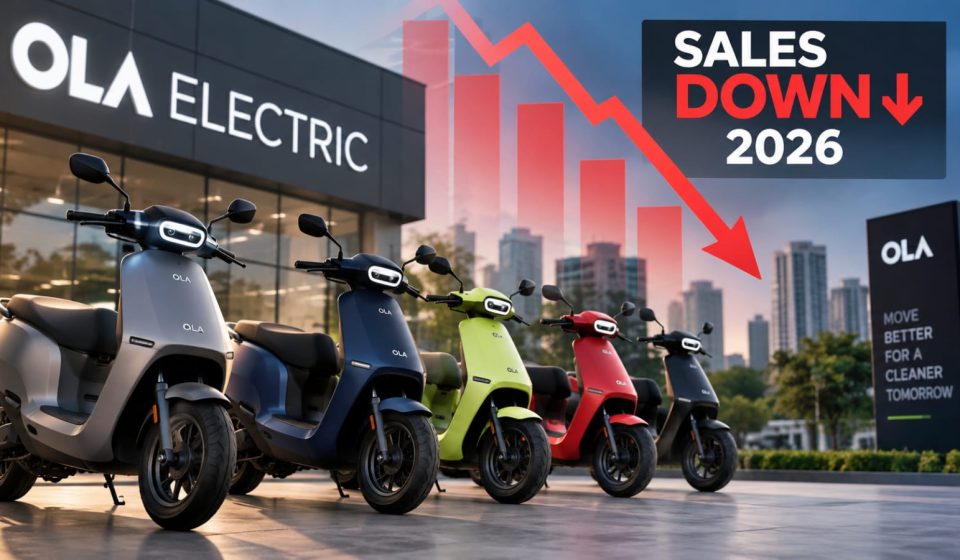
Ola Electric Registrations Fall 44% in H1 2026 Even as India’s EV Two-Wheeler Market Grows 53%

Ola Electric’s position in India’s electric two-wheeler market has changed sharply in 2026. The company recorded 65,999 retail registrations between January and June, down 44.1% from 1,18,032 units in the same period of 2025.
The decline came even as the overall electric two-wheeler market expanded 53.3% year-on-year to 9,70,993 registrations, from 6,33,599 in H1 2025, according to FADA data. Ola’s share consequently fell from 18.6% to 6.8%.
The shift is particularly significant because the additional demand in the market did not disappear. TVS Motor, Bajaj Auto, Ather Energy and Hero MotoCorp’s Vida business together accounted for 3,22,621 of the industry’s 3,37,394 additional registrations, or 95.6% of the net increase during the first six months.
That makes Ola’s 2026 story less about a slowdown in electric two-wheeler demand and more about a change in where that demand is going.
Ola Electric H1 2026 Registrations vs H1 2025
| Manufacturer | H1 2025 (Jan-Jun’25) | H1 2026 (Jan-Jun’26) | YoY change |
|---|---|---|---|
| TVS Motor | 1,51,707 | 2,51,438 | +65.7% |
| Bajaj Auto | 1,47,407 | 2,18,089 | +48.0% |
| Ather Energy | 88,453 | 1,69,020 | +91.1% |
| Hero MotoCorp/Vida | 34,378 | 1,06,019 | +208.4% |
| Ola Electric | 1,18,032 | 65,999 | -44.1% |
Source: FADA registration data as reported by Business Standard. These are retail registrations, not factory dispatches.
The four growing manufacturers added 3,22,621 registrations between the two periods, while Ola alone lost 52,033. The industry itself added 3,37,394 registrations.
In other words, the market grew by more than half, but Ola did not participate in that expansion at the same pace as its major rivals.
Ola’s Market Share Fell From 18.6% to 6.8%
Ola entered 2026 with a sizeable share of India’s electric two-wheeler market, but its position weakened rapidly during the first half.
Its market share dropped from 18.6% in H1 2025 to 6.8% in H1 2026. By comparison, TVS increased its share from 23.9% to 25.9%, Ather moved from 14% to 17.4%, and Hero’s share increased from 5.4% to 10.9%. Bajaj remained a major player at 22.5% in H1 2026.
The combined share of TVS, Bajaj, Ather and Hero rose from 66.6% to 76.7% over the same period.
This concentration is important because the competition is no longer being driven only by new EV startups. Large two-wheeler manufacturers with established retail and service networks are now accounting for a substantial portion of India’s electric scooter registrations.
Ola’s Monthly Numbers Improved, But the H1 Gap Remains
Ola started the year at a much lower monthly volume, registering 7,808 electric two-wheelers in January. Registrations subsequently increased, reaching 16,144 units in June, according to VAHAN data cited by the company.
Ola’s April registrations were 12,166 units, followed by 15,139 in May and 16,144 in June. May represented a 23% month-on-month increase over April.
The quarterly comparison also shows the improvement. Ola registered about 43,719 units in April-June, compared with 22,252 in January-March, according to VAHAN data cited by the company.
So there are two different trends in the data:
- Year-on-year: Ola remained significantly weaker in H1 2026.
- Quarter-on-quarter: registrations improved sharply during the first half.
That distinction matters. A recovery from a weak starting point is not the same as a recovery in market share.
Service Became a Major Part of Ola’s Business Reset
Ola’s sales and registration decline followed a period in which service capacity, parts availability and customer experience became important issues for the company.
Ola itself identified service as a major constraint on demand and brand trust during FY26. The company said average service turnaround time fell from about nine days in October 2025 to nearly one day in March 2026, while same-day closures improved to nearly 87%. It also said service backlog declined from 14 days to six days and parts pendency fell 69% between October and April.
These figures are company-reported metrics, rather than an independent assessment of customer satisfaction.
The company linked the improvement in service operations with the subsequent recovery in registrations. That establishes Ola’s explanation for the recovery, but it does not by itself prove that service problems were responsible for the entire H1 decline.
Ola Is Also Changing Its Retail Strategy
Ola’s distribution model is changing at the same time.
In September 2026, the company opened its first batch of dealer-operated stores across seven states and said it was targeting more than 500 dealerships over the following quarters. Existing company-owned outlets are being transitioned into product experience centres.
The move is significant because established manufacturers such as TVS, Bajaj and Hero already have extensive physical retail and service networks.
For an electric scooter buyer, the purchase decision is not limited to battery capacity or claimed range. Access to a service centre, availability of parts, warranty support and confidence in after-sales assistance can also affect the decision.
Ola is therefore trying to expand volume while simultaneously changing how customers buy and service its products.
TVS, Bajaj, Ather and Vida Have Expanded at Different Ends of the Market
The competitive pressure on Ola has increased as rival manufacturers have added products and expanded their existing EV portfolios.
Bajaj Chetak C25
Bajaj launched the Chetak C25 in January 2026 at ₹91,399 ex-showroom Bengaluru. The scooter uses a 2.5kWh battery and has a claimed range of up to 113km.
The C25 gave Bajaj another product at the more affordable end of its Chetak portfolio, while the brand’s overall electric two-wheeler registrations rose 48% to 2,18,089 units in H1 2026.
TVS Orbiter
TVS launched the Orbiter in August 2025 at ₹99,900 ex-showroom Bengaluru, including the applicable PM E-Drive benefit at launch. It uses a 3.1kWh battery and has a claimed IDC range of 158km. TVS also equipped it with features such as cruise control, hill-hold assist and a 34-litre boot.
TVS subsequently recorded 2,51,438 electric two-wheeler registrations in H1 2026, a 65.7% increase over the year-earlier period.
Hero Vida
Hero MotoCorp’s Vida business also recorded a sharp increase. Registrations rose from 34,378 units in H1 2025 to 1,06,019 in H1 2026, an increase of 208.4%.
Vida’s battery-as-a-service model for the VX2 was designed to reduce the upfront ownership cost by separating the scooter and battery payments through subscription plans. Hero announced the model in June 2025 ahead of its July rollout.
Ather Rizta
Ather’s growth has been closely linked to the Rizta, its family-oriented electric scooter.
Ather said in May 2026 that the Rizta had crossed 3 lakh cumulative sales, with the model accounting for 76% of Ather’s total sales volume in FY26.
Ather’s H1 2026 registrations increased 91.1% to 1,69,020 units, taking its market share to 17.4% from 14% a year earlier.
Ather’s Konarc Adds Another Mass-Market Option
Competition has widened further in the second half of 2026 with the arrival of the Ather Konarc.
Ather launched the Konarc in August with an introductory price of ₹99,999. The company positions it as an everyday scooter, and the model uses a metal body, steel unibody chassis and 14-inch front wheel.
The currently available Konarc S variants offer claimed IDC ranges of 100km, 125km and 161km, while Ather has also outlined higher-range versions for the future.
The significance for Ola is not simply another model entering the market. The Konarc expands Ather’s presence into a price-sensitive family-scooter segment where established manufacturers are already competing aggressively.
What About Individual Ola S1 Model Sales?
There is considerable interest in separate H1 2026 numbers for the S1 Pro, S1 X, S1 Air and individual battery variants. But the FADA data cited in the H1 market reports provides Ola’s registration figure at the manufacturer level rather than a complete, independently verifiable six-month variant-level series.
That means the 65,999 figure should not be divided among individual S1 variants unless the underlying registration data is available.
This distinction is important because Ola’s product range has also changed during the period. The company now lists products including the S1 Z, S1 X+, S1 X and S1 Pro, with different battery configurations and prices.
For that reason, model-wise H1 sales tables circulating without a clearly identified underlying dataset should be treated cautiously.
August 2026 Shows the Competitive Gap Is Still Visible
The latest available monthly data provides another snapshot of the market.
India recorded 1,83,204 electric two-wheeler retail registrations in August 2026, up 67.05% from 1,09,673 in August 2025. Registrations were down 10.35% from July’s 2,04,362 units, while electric two-wheelers accounted for about 10.7% of the overall two-wheeler market.
The leading manufacturers were:
| Brand | August 2026 | August 2025 | YoY change |
|---|---|---|---|
| TVS Motor | 48,938 | 25,646 | +90.8% |
| Bajaj Auto | 41,114 | 12,246 | +235.7% |
| Ather Energy | 28,757 | 19,210 | +49.7% |
| Hero MotoCorp | 19,007 | 13,769 | +38.0% |
| Ola Electric | 13,852 | 19,464 | -28.8% |
Source: FADA data reported by ETAuto.
Ola was the only manufacturer among the top five to record a year-on-year decline in August. At the same time, its month-on-month decline was relatively small compared with most of its major rivals.
That is worth separating from the annual comparison: August does not show a collapse in the overall EV market. Instead, it shows continued growth alongside a very uneven performance between manufacturers.
Why Are Ola Electric Registrations Down?
Competition has intensified. TVS, Bajaj and Hero have brought established brands and large retail networks into the EV market, while Ather has expanded beyond its earlier performance-oriented positioning.
Service became an operational priority for Ola. The company has reported substantial improvements in turnaround times, backlog and same-day closures, but those improvements came after service had already become a major issue for the business.
Product choice has widened. Buyers now have more electric scooters across the ₹1 lakh-plus and sub-₹1 lakh price bands, with products designed for commuters, families and first-time EV buyers.
Distribution is changing. Ola’s move towards dealer-operated stores suggests the company is placing greater emphasis on physical retail and service reach.
None of these factors, individually, proves that it caused the H1 decline. Together, however, they help explain why a rapidly growing EV category has produced very different outcomes for individual manufacturers.
Ola Is Trying to Compete at the Value End
The S1 Z starts at an introductory ₹79,999, according to Ola’s current product information. The scooter is offered with 3.1kWh and 5.1kWh battery options, with claimed IDC ranges of 179km and 301km respectively.
Ola has also launched the S1 X+ with a 5.2kWh battery using its 4680 Bharat Cell technology. The company disclosed the product launch to the stock exchanges in April 2026.
These products are part of Ola’s broader attempt to compete across more price points while increasing the role of its own battery technology.
But product pricing is only one part of the equation. Buyers are also comparing range, charging, service access, spare parts, warranty coverage, software and the overall ownership experience.
The Bigger Shift Is in Who Is Capturing EV Growth
It is that the Indian electric two-wheeler market is growing while becoming more competitive and concentrated around a smaller group of manufacturers.
TVS, Bajaj, Ather and Hero together accounted for 76.7% of H1 2026 electric two-wheeler registrations, up from 66.6% a year earlier.
For Ola, that changes the nature of the challenge.
The company is not trying to persuade customers to buy electric scooters in a market where few alternatives exist. It is competing for those customers against manufacturers that already have significant scale, physical distribution and established two-wheeler brands.
What Happens Next for Ola Electric?
Ola’s next phase will be closely tied to three areas: product range, distribution and ownership experience.
The company is expanding its portfolio, introducing lower-priced products and moving towards a dealer-led retail and service structure. Its reported service metrics have also improved substantially from the levels seen during FY26.
The H1 numbers, however, show that operational recovery has not yet translated into a restoration of Ola’s previous market share.
The August data points in the same direction: India’s electric two-wheeler market continues to expand, while Ola’s registrations remain below their year-earlier level.
For the remainder of 2026, the key metric will therefore be less about whether India’s EV market grows and more about whether Ola’s own registrations can grow faster than the category and begin closing the market-share gap.
Stay updated with latest EV development, market insights, growth story, new market opportunities with Indus ev.
FAQs
Why did Ola Electric registrations fall in 2026?
Ola Electric’s H1 2026 registrations fell 44.1% year-on-year to 65,999 units. There is no single officially confirmed reason for the decline. The company has been addressing service operations, retail execution and product availability while facing stronger competition from TVS, Bajaj, Hero and Ather.
How many electric two-wheelers did Ola Electric register in H1 2026?
Ola Electric recorded 65,999 retail registrations between January and June 2026, compared with 1,18,032 in H1 2025.
Did India’s electric two-wheeler market decline in H1 2026?
No. India’s electric two-wheeler registrations increased 53.3% year-on-year to 9,70,993 units in January-June 2026 from 6,33,599 units in the corresponding period of 2025.
Which electric scooter company sold the most in H1 2026?
Based on FADA retail registration data, TVS Motor recorded the highest electric two-wheeler volume in H1 2026 at 2,51,438 units, followed by Bajaj Auto at 2,18,089 units.
What happened to Ola Electric’s market share in 2026?
Ola Electric’s share of India’s electric two-wheeler registrations fell from 18.6% in H1 2025 to 6.8% in H1 2026.
Which companies gained the most from India’s electric two-wheeler growth?
TVS Motor, Bajaj Auto, Ather Energy and Hero MotoCorp’s Vida business together accounted for 95.6% of the industry’s incremental H1 registrations between 2025 and 2026.
Did Ola Electric’s monthly registrations improve during 2026?
Yes. Ola’s registrations rose from 7,808 units in January to 16,144 units in June. Its April-June registrations were also nearly twice the January-March level.
How many electric two-wheelers did Ola register in August 2026?
Ola Electric recorded 13,852 retail registrations in August 2026, down 28.83% from 19,464 units in August 2025, according to FADA data reported by ETAuto.
Which electric two-wheeler brand led India in August 2026?
TVS Motor led the electric two-wheeler market in August 2026 with 48,938 retail registrations, followed by Bajaj Auto with 41,114 and Ather Energy with 28,757.
Are Ola Electric’s individual S1 model sales available for H1 2026?
A complete, independently verifiable six-month model-level registration breakdown for the S1 Pro, S1 X, S1 Air and individual battery variants is not established by the FADA manufacturer-level data used for the H1 comparison. Model-wise numbers should therefore not be inferred from Ola’s total 65,999 registrations.
What is the starting price of the Ola S1 Z?
Ola’s current product information lists the S1 Z at an introductory ₹79,999, with a 3.1kWh version offering a claimed 179km IDC range and a 5.1kWh version offering a claimed 301km IDC range. These are manufacturer-claimed figures.
Is the Ather Konarc competing with Ola?
The Ather Konarc is positioned as a more accessible, everyday electric scooter, with its entry variant priced at ₹99,999 ex-showroom. It adds another product in the price-sensitive part of the electric scooter market where Ola also competes.
Sources:
Angel One and Autocar Pro support the Chetak production disruption in 2025.
Outlook Business supports the H1 market total, Ola’s 65,999 units, the share fall and the 95.6% figure.
Rushlane supports the August FADA totals, the “only decliner among top eight” claim and Ola’s −1.8% month-on-month change.
Autocar Pro supports Ola’s 17.7% August 2025 share (Nuvama’s VAHAN-based compilation).
Business Standard supports Ola’s May 15,139 figure, its April figure of 12,323 and its stated reasons for the recovery.
Inc42 and The Machine Maker support the dealer-store rollout, the August 6 date and the 500+ target.
Autoguide India supports S1Z prices, claimed ranges and delivery timelines.